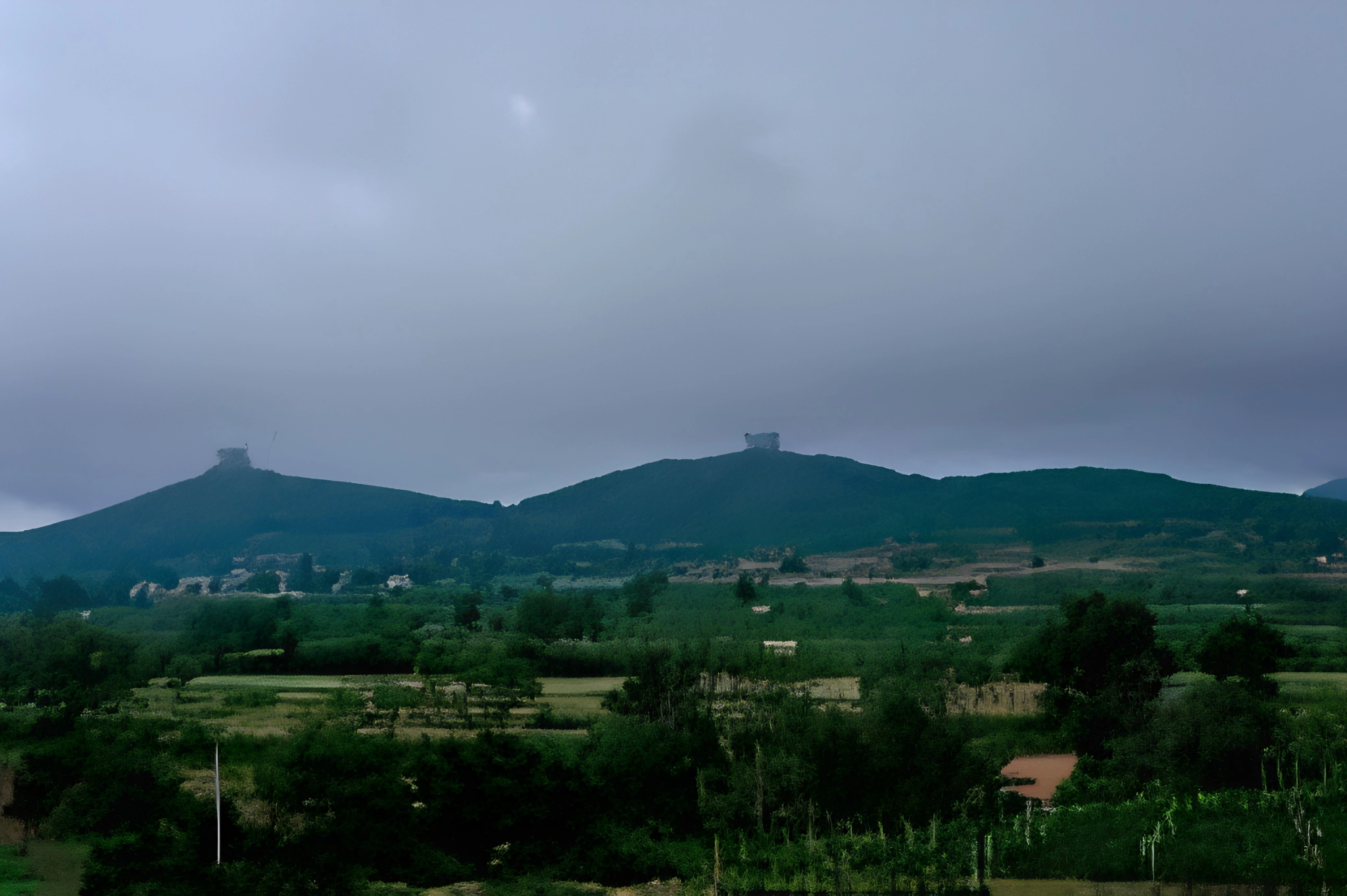
Eighty-five kilometres northwest of Xi’an, on the southern slope of a 1,047-metre limestone peak called Mount Liangshan, a stone road climbs gently between two avenues of weathered statues — pairs of winged horses, ostriches, tigers, a pair of stone pillars, twenty officials in court dress, twenty generals in armour — toward a hill that, from a distance, looks like the breast of a sleeping woman. The local farmers have always called it Naitouling. The Breast Hill.
Beneath that hill lies the largest, most intact, and most genuinely mysterious imperial tomb in China.
It is the joint mausoleum of Emperor Gaozong of the Tang Dynasty, who died in 683 AD, and his widow Wu Zetian, who in 690 AD declared the Tang Dynasty deposed, named a new dynasty after herself — the Zhou — and ruled the Chinese empire for the next fifteen years as its first, last, and only female emperor. She was buried beside her husband in 705 AD, having been forced from power ten months earlier in a palace coup. She was eighty-one years old.
In the 1,321 years since, the Qianling Mausoleum has resisted at least seventeen recorded attempts at grave robbing — by Tang rebels, by Song bandits, by Ming warlords, by Republic-era armies equipped with modern explosives. None succeeded. As of May 2026, the central burial chamber has never been opened. What is inside is, almost uniquely among China’s imperial tombs, exactly what was placed inside in 705 AD. The Chinese government has formally refused all proposals to excavate it, on the grounds that current technology cannot yet preserve what would be exposed.
This is, in other words, the closest thing in China to an unopened pyramid. And in front of the tomb stand sixty-one headless stone diplomats and a single uninscribed limestone tablet — two of the most discussed unsolved mysteries in Chinese historiography.
Here is what is actually at Qianling, and why it deserves a day trip from Xi’an for anyone interested in the imperial story China has been telling itself for two thousand years.
The Woman in the Mountain: Why Wu Zetian Matters
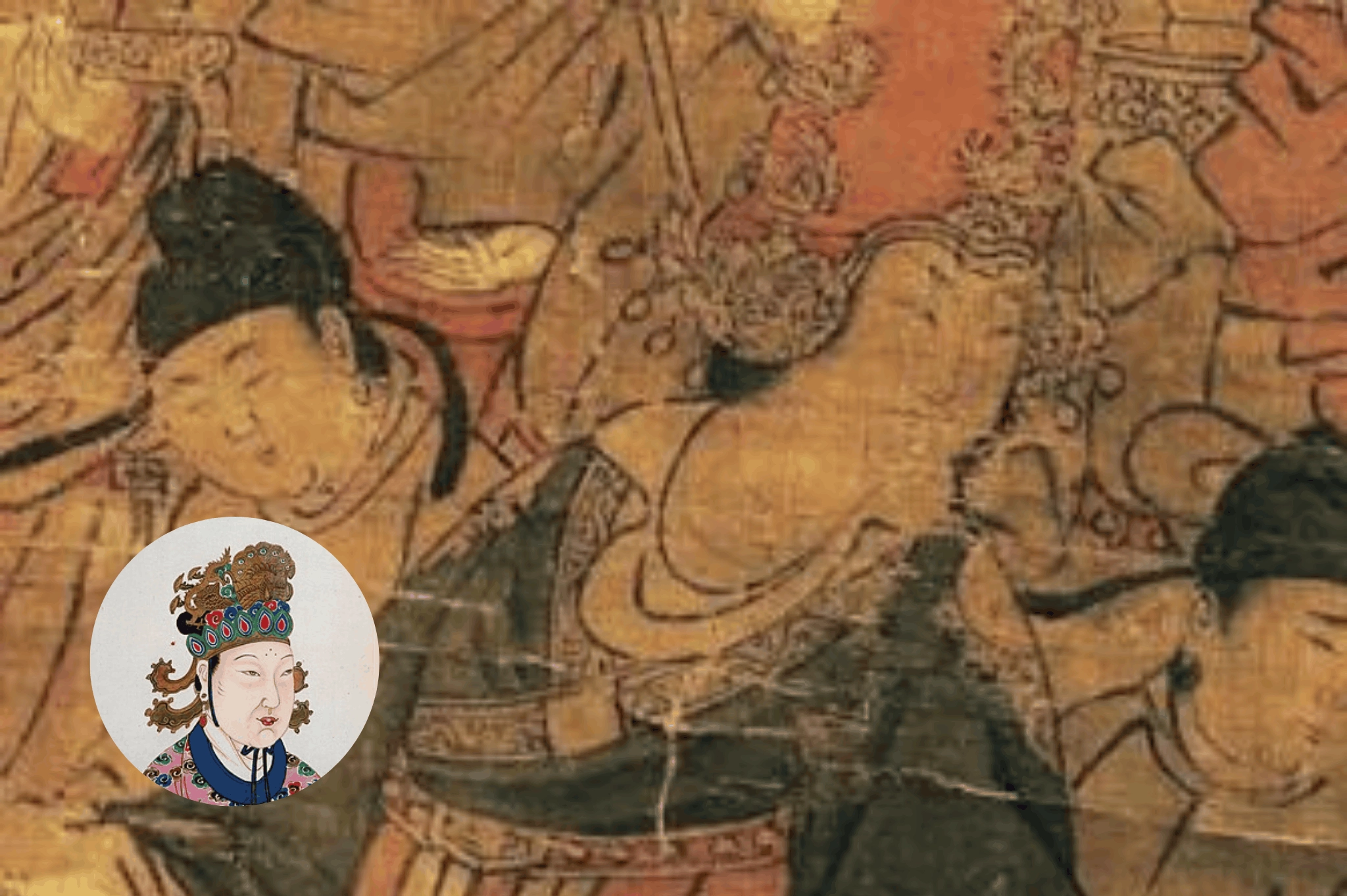
To understand Qianling you have to understand the woman buried beneath it.
Wu Zhao, later known as Wu Zetian, was born in 624 AD into a wealthy but non-aristocratic merchant family from Shanxi. At fourteen she was selected as a low-ranking concubine of the Emperor Taizong, the second emperor of the Tang Dynasty. By the conventions of the time, when Taizong died in 649 AD she should have been sent to a Buddhist convent and erased from history. Instead, Taizong’s son and successor, the Emperor Gaozong, recalled her to court, demoted his existing empress, executed two of his senior concubines, and married her. Within five years she had effectively taken over the administration of the empire from her chronically ill husband.
When Gaozong died in 683 AD, Wu ruled through two sons in succession, deposing both. In 690 AD she dispensed with the fiction. She declared herself Emperor — Huangdi, the masculine title, not Empress — founded a new dynasty called the Zhou, and ruled in her own name for fifteen years. She was the only woman in Chinese history to do so. The standard narrative, written by the male Confucian historians of the subsequent Tang restoration, describes her as a tyrant, a poisoner, a usurper, and a Buddhist heretic. Modern scholarship is considerably kinder: under her reign the Tang civil service exam was reformed to admit non-aristocratic candidates, agricultural production rose, the western Tang frontier reached its greatest extent, and Buddhist art and architecture flourished. The famous colossal Buddha at the Longmen Grottoes near Luoyang, modelled on her face, was carved during her reign.
In 705 AD, aged eighty-one and bedridden, she was forced to abdicate by a palace coup that restored her son to the throne. She died ten months later. By her own final instruction, she was buried beside her husband Gaozong at Qianling — and her own tombstone, the famous Wuzibei, was left blank.
The Sacred Way: A Two-Kilometre Walk Through Tang Cosmology
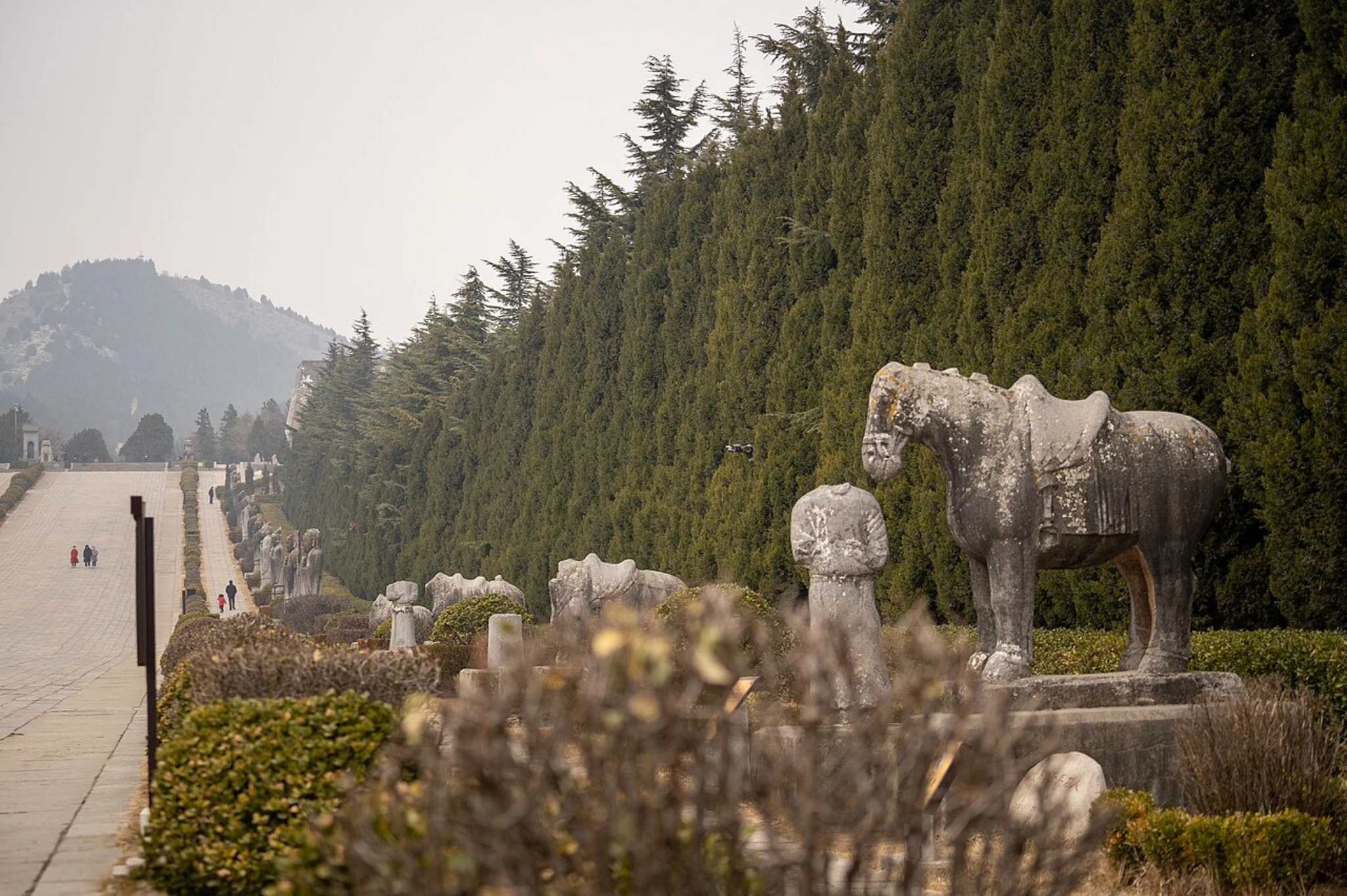
The visit to Qianling begins not at the tomb itself but at the foot of the southern slope, where a 2-kilometre stone-paved processional road — the Shendao, or Spirit Way — climbs gently toward the central mound. Along its full length are aligned 124 large stone sculptures, arranged in symmetrical pairs facing inward across the road.
Walking north up the Sacred Way you pass, in order: a pair of stone watchtowers, a pair of winged horses (the heavenly steed tianma, a symbol of the imperial soul ascending), a pair of stone ostriches (a tribute from a Central Asian kingdom — Tang Chang’an was a polyglot Silk Road capital), five pairs of stone horses with grooms, ten pairs of armoured generals, ten pairs of civil officials in court dress, and the famous twin stone pillars that mark the formal entrance to the sacred precinct. The carving is unmistakably Tang: confident, broad-shouldered, slightly heavy, with the realism of an empire at its self-assured peak.
It is at the top of this avenue, immediately in front of the inner gate, that you encounter the two great mysteries of Qianling — standing about thirty metres apart from each other.
The First Mystery: The 61 Headless Stone Envoys
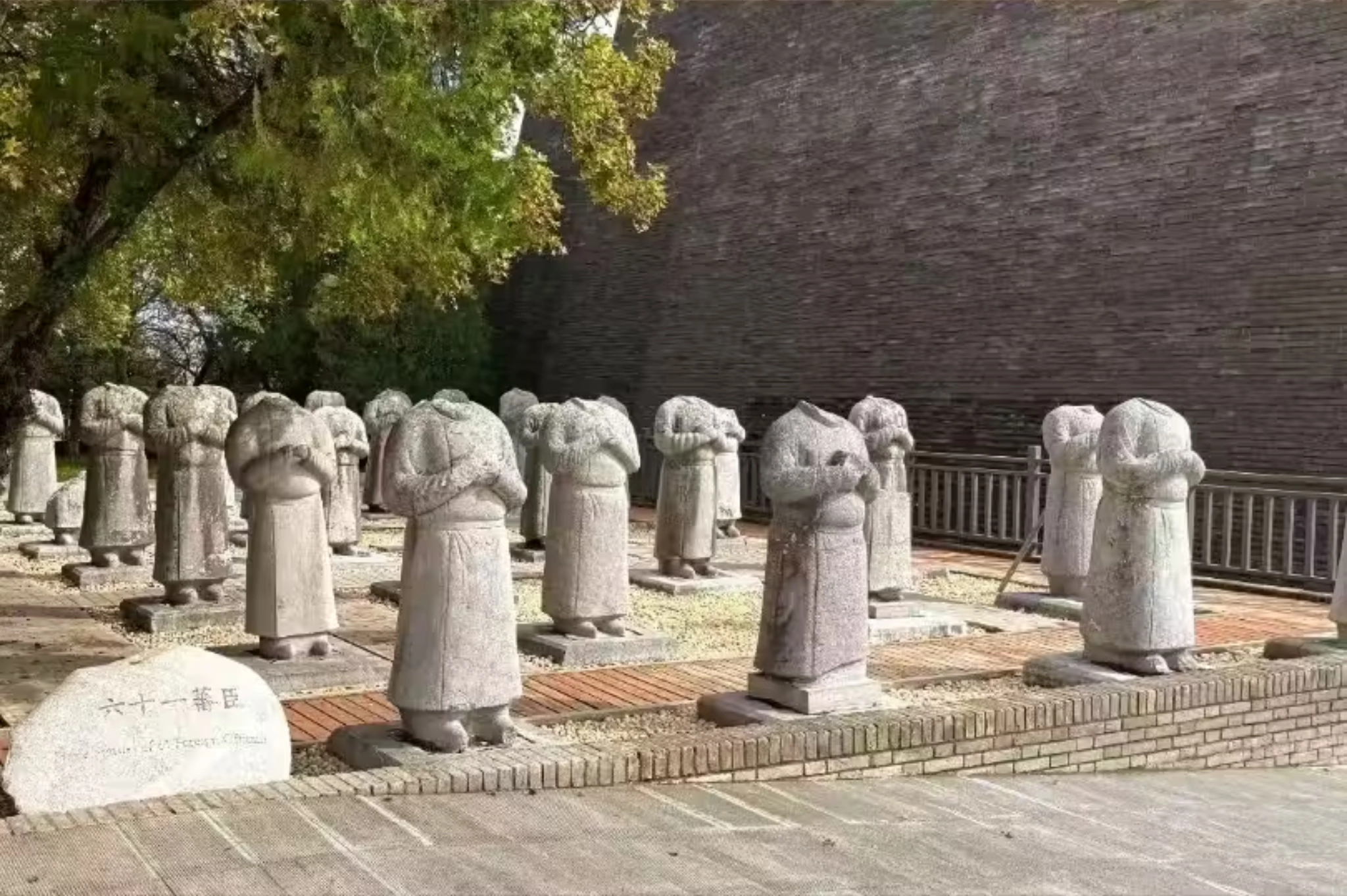
On the western side of the inner avenue stand sixty-one life-sized stone figures, each carved from a single block of grey limestone, each dressed in the distinctive court costume of a foreign nation, each with their hands clasped in formal Tang Dynasty mourning posture.
Every single one of them is decapitated.
According to the carved inscriptions on their backs — many still partially legible, others recorded in Song Dynasty antiquarian texts before they were lost — these figures represent the sixty-one foreign princes, kings, and envoys who came in person to Chang’an in 684 AD to attend the funeral of the Emperor Gaozong. They include kings from Tibet, from the Korean kingdom of Silla, from the Western Turks, from Persia (then in exile after the Arab conquest), from the various oasis kingdoms of the Tarim Basin, from Japan, from the Indian state of Kashmir, and from the Eastern Roman (Byzantine) Empire. Wu Zetian, then acting as regent, ordered their likenesses carved at the entrance to her husband’s tomb as a permanent demonstration of the Tang Dynasty’s international standing. They have stood here for 1,342 years.
But none of them have heads.
The most popular folk explanation — the one your tour guide will most likely tell you — is that during the late Ming Dynasty a band of foreign visitors recognised their own ancestors among the statues, were humiliated by the servile posture, and decapitated them in a single overnight raid. This is almost certainly untrue. The more accepted academic explanation, supported by farmer-recovered fragments dug up in nearby fields in 1971, is that the heads were broken off in a massive earthquake that struck Guanzhong in 1556 AD — the deadliest earthquake in recorded human history, which killed an estimated 830,000 people — and that subsequent collectors and farmers carried the fallen heads away over the following centuries. A few heads, mostly damaged, have been recovered. Dozens remain missing.
The effect of walking past them is unsettling and unforgettable. Sixty-one stone diplomats, dressed in the distinctive robes of half of Eurasia, standing in perpetual silent mourning, facing the tomb of an emperor who died thirteen hundred years ago, in a posture of subordination that the modern viewer can read instantly. It is one of the most powerful single visual experiences in Chinese imperial archaeology.
The Second Mystery: The Wordless Stele
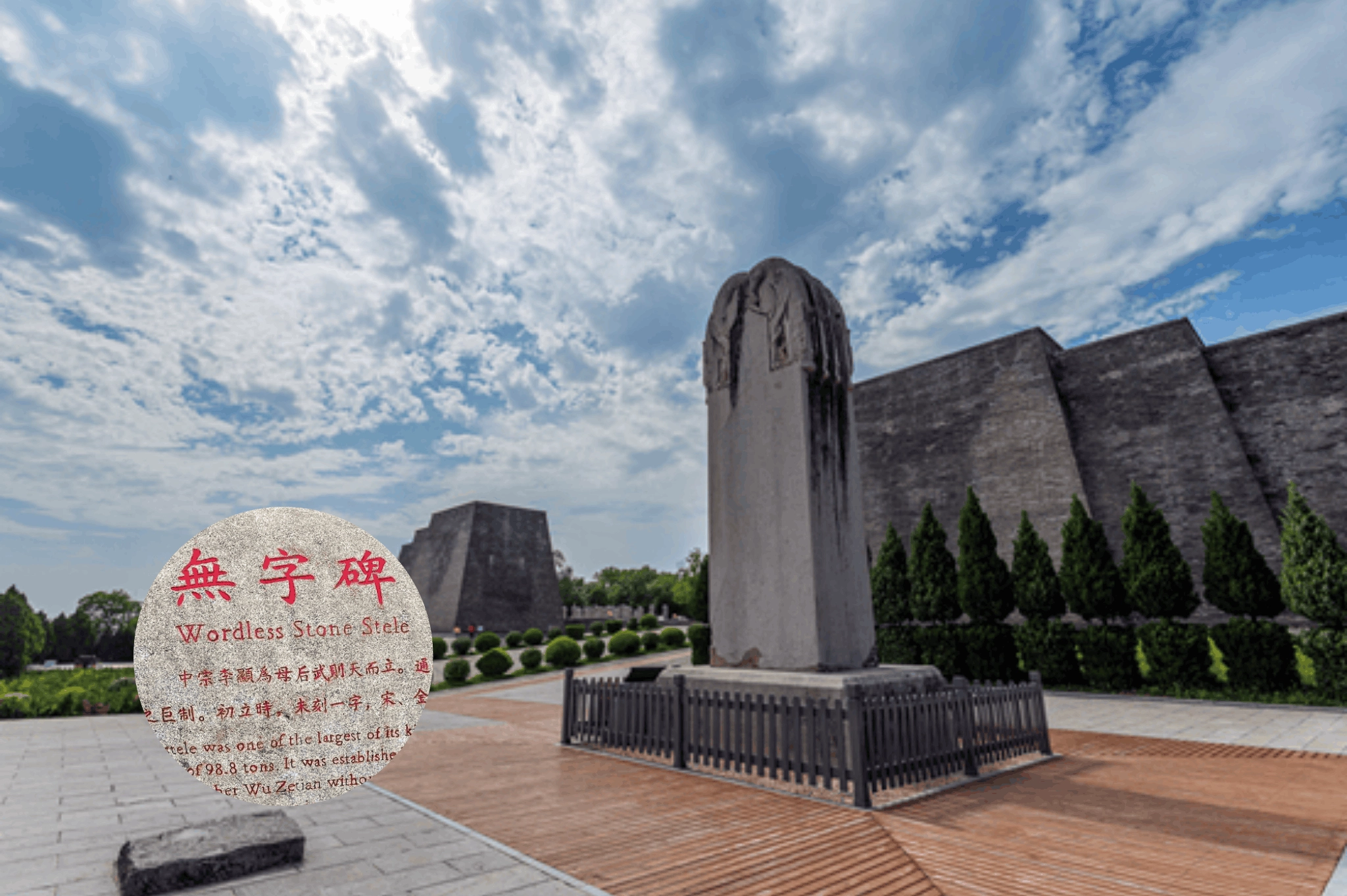
On the eastern side of the inner avenue, directly opposite the 61 envoys, stand two large stone tablets, each over six metres tall, each carved from a single piece of pale limestone.
The western tablet — the Shushengji Bei, the Stele of the Sage’s Achievements — is densely carved on all four sides with an 8,000-character text composed by Wu Zetian herself in 683 AD, eulogising the achievements of her late husband. It is one of the longest single inscribed Tang texts in existence.
The eastern tablet — the Wuzibei, the Wordless Stele — is, more than thirteen centuries after its erection, still completely uninscribed. Its surface is smooth, dressed limestone. There is no eulogy. There is no list of titles. There is no record of the deeds of the woman buried beneath the hill behind it. It is the tombstone of China’s only female emperor, and she left it blank.
The traditional Confucian interpretation, dating from the Song Dynasty, is that Wu Zetian erected the blank stele in modesty, recognising that her achievements were too great to be expressed in words. The traditional Confucian-revisionist interpretation, also Song Dynasty, is that she left it blank because she was too ashamed of her crimes to record them. The modern interpretation, suggested by twentieth-century historians sympathetic to her reign, is that she left it blank as a deliberate act of historiographic defiance — a refusal to be evaluated by the Confucian standards under which any woman who ruled the empire was already, by definition, condemned. “Let later generations write what they will,” is the phrase usually associated with the gesture.
Thirteen centuries later, later generations have written rather a lot. The stele, however, remains blank. Several smaller Song, Jin, and Yuan Dynasty inscriptions were added to its surface by visiting officials in the centuries after Wu’s death — graffiti, essentially — but its central face is empty. The argument it makes is more powerful for being silent.
What Is (Probably) Inside the Tomb
The central mound, behind the inner gate, is the natural summit of Mount Liangshan. Tang engineers tunnelled directly into the mountain itself, creating a horizontal stone passageway 631 metres long that leads to the burial chamber deep beneath the peak. The passageway was sealed in 705 AD with several thousand carefully shaped interlocking stone blocks set in molten iron, in a technique developed specifically to defeat grave robbers. It worked.
Twentieth-century geophysical surveys — most recently a 2003 ground-penetrating radar study by the Shaanxi Provincial Archaeological Institute — have confirmed that the burial chamber is intact, that the sealing system remains undisturbed, and that the chamber itself is approximately the size of a large modern apartment. What is inside is unknown, but historical records of Tang imperial burial practice suggest the following are very likely present: the bodies of Gaozong and Wu Zetian in stone sarcophagi, several thousand pieces of gold and jade funeral goods, a complete set of Tang Dynasty court robes, ceramic and bronze vessels, and — most tantalisingly — the lost original of the Lanting Xu, Wang Xizhi’s Preface to the Lanting Pavilion, the most famous single piece of calligraphy in Chinese history, which the Emperor Taizong is recorded to have demanded be buried with him but which several Tang sources suggest was actually buried at Qianling.
There has been considerable scholarly pressure since the 1960s to open the tomb. Each request has been denied. The current official position, restated as recently as 2024, is that the tomb will remain sealed until conservation technology has advanced sufficiently to preserve, in situ, whatever silk, lacquer, paper, and pigment lies inside. The most likely date for excavation is “not in our lifetimes.”
In other words: somewhere under the hill in front of you, in a perfectly dry stone chamber, untouched by daylight for thirteen centuries, is a complete sealed snapshot of the apex of Tang Dynasty civilisation. And no one is going in.
Practical Information
Location: Qianling Mausoleum, Liangshan, Qian County, Xianyang, Shaanxi. Approximately 85 km northwest of central Xi’an.
Getting there: Tour bus is by far the easiest option (most Xi’an half-day or full-day tours combine Qianling with Famen Temple). Independent travellers can take a long-distance bus from Xi’an City West Bus Station (approx. 2 hours, 30 RMB) or hire a private driver (300–500 RMB round trip).
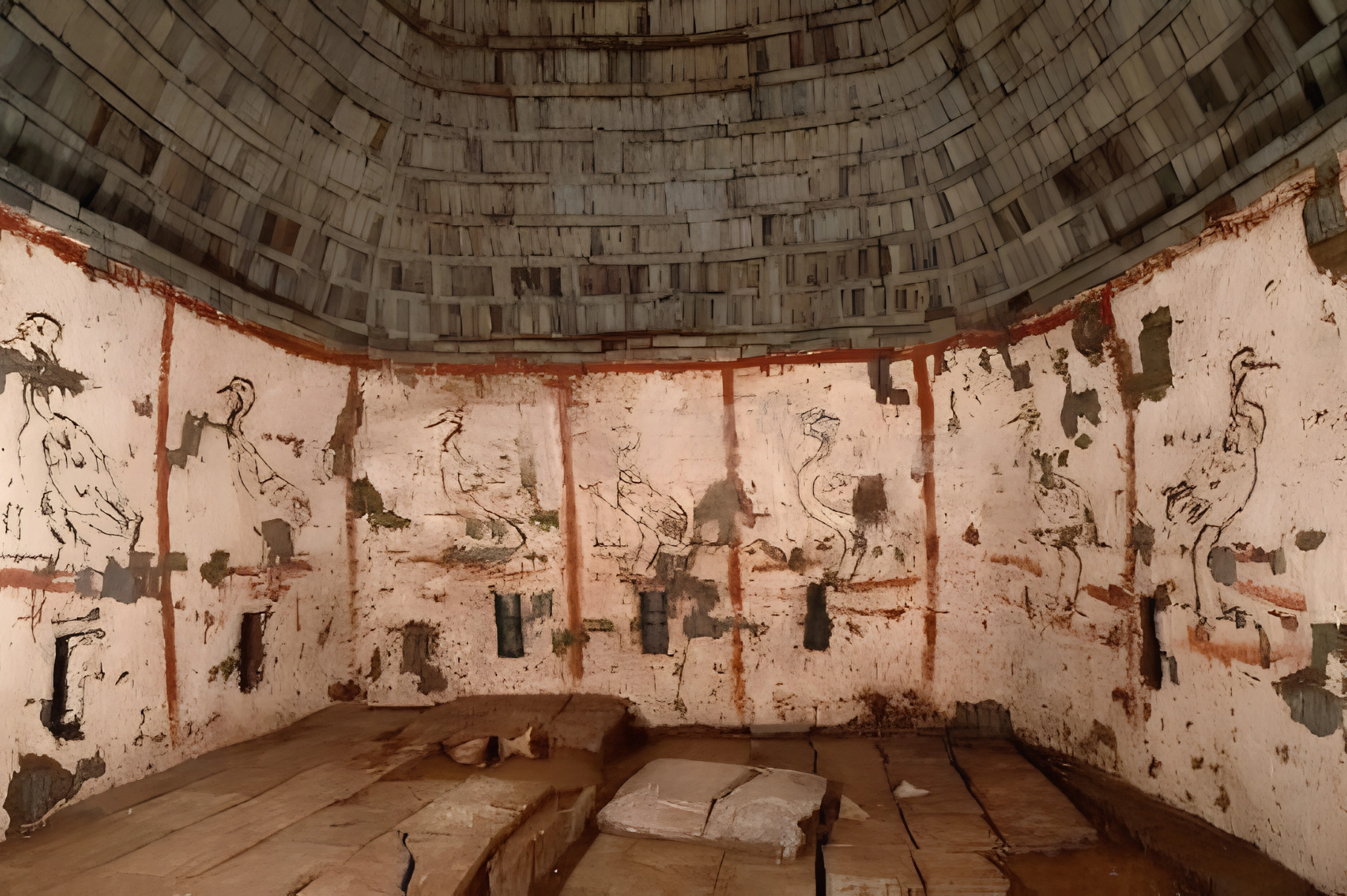
Admission: 122 RMB (March–November); 82 RMB (December–February). Includes the main mausoleum and the satellite tomb of Princess Yongtai, which holds a remarkable set of Tang Dynasty murals.
Time required: A focused visit takes 2.5 to 3 hours. A full visit including Princess Yongtai’s tomb, the on-site museum, and the satellite tombs of Crown Prince Yide and Crown Prince Zhanghuai is a full day.
Best combined with: Famen Temple (75 km further west, holds the world’s only authenticated finger bone of the Buddha) and the Yang Guifei Tomb (35 km east). Most Xi’an tour operators run the Qianling + Famen full-day circuit.