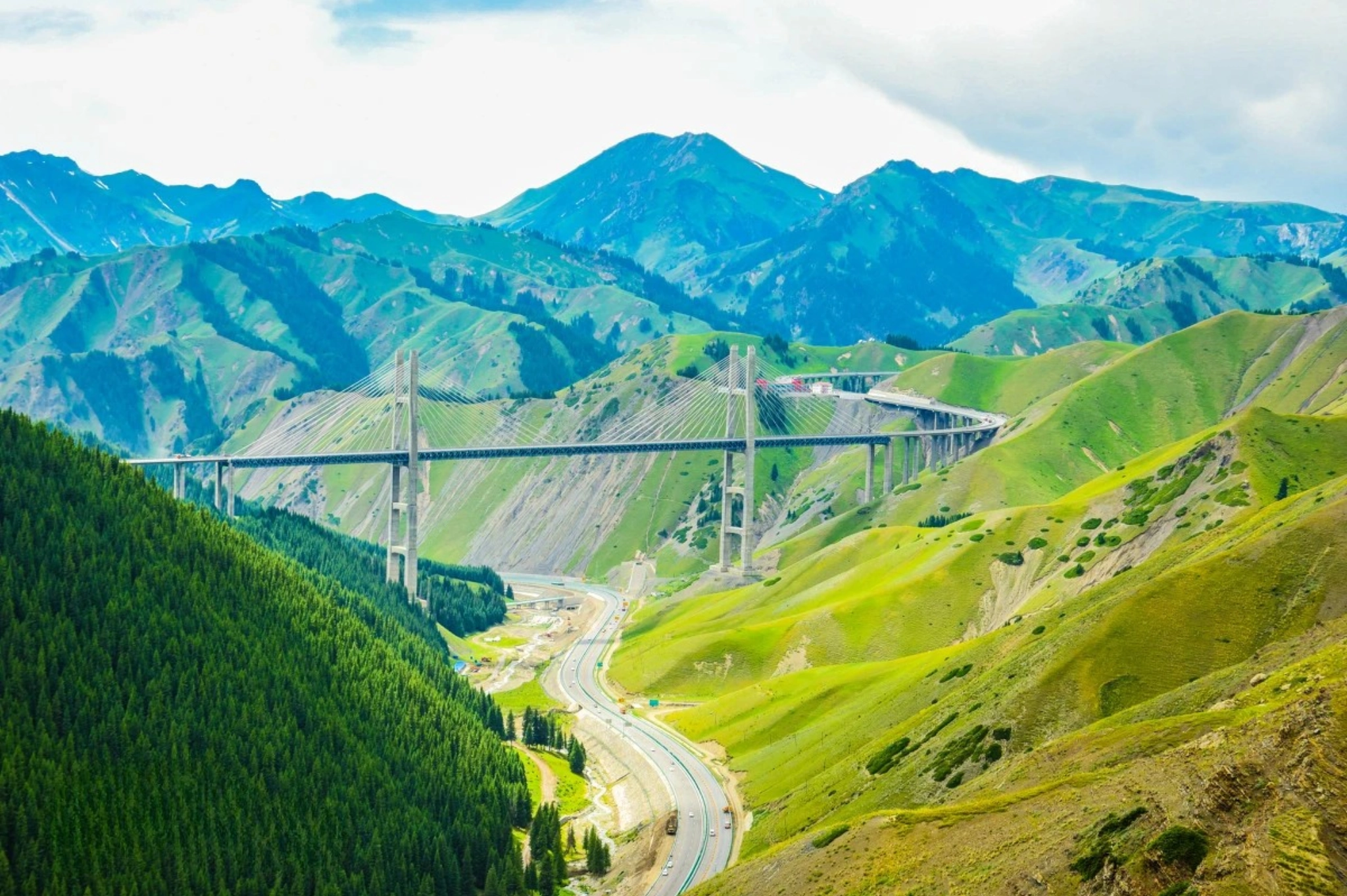
There is a moment on the drive from Sayram Lake down into the Ili Valley when the road appears to leave the earth entirely. The mountains fold in, the gorge drops away beneath you, and the highway lifts onto a slender ribbon of steel suspended in mid-air, so high that the spruce trees on the valley floor look like moss and the rivers like threads of tin. This is Guozigou (果子溝) — literally "Fruit Valley" — the great northern gateway into Ili, and one of the most dramatic stretches of road anywhere on the old Silk Road. It is named for its apples. It is remembered for its bridge. And in autumn it is simply one of the most beautiful places in Xinjiang.
A Gorge Named for Wild Fruit
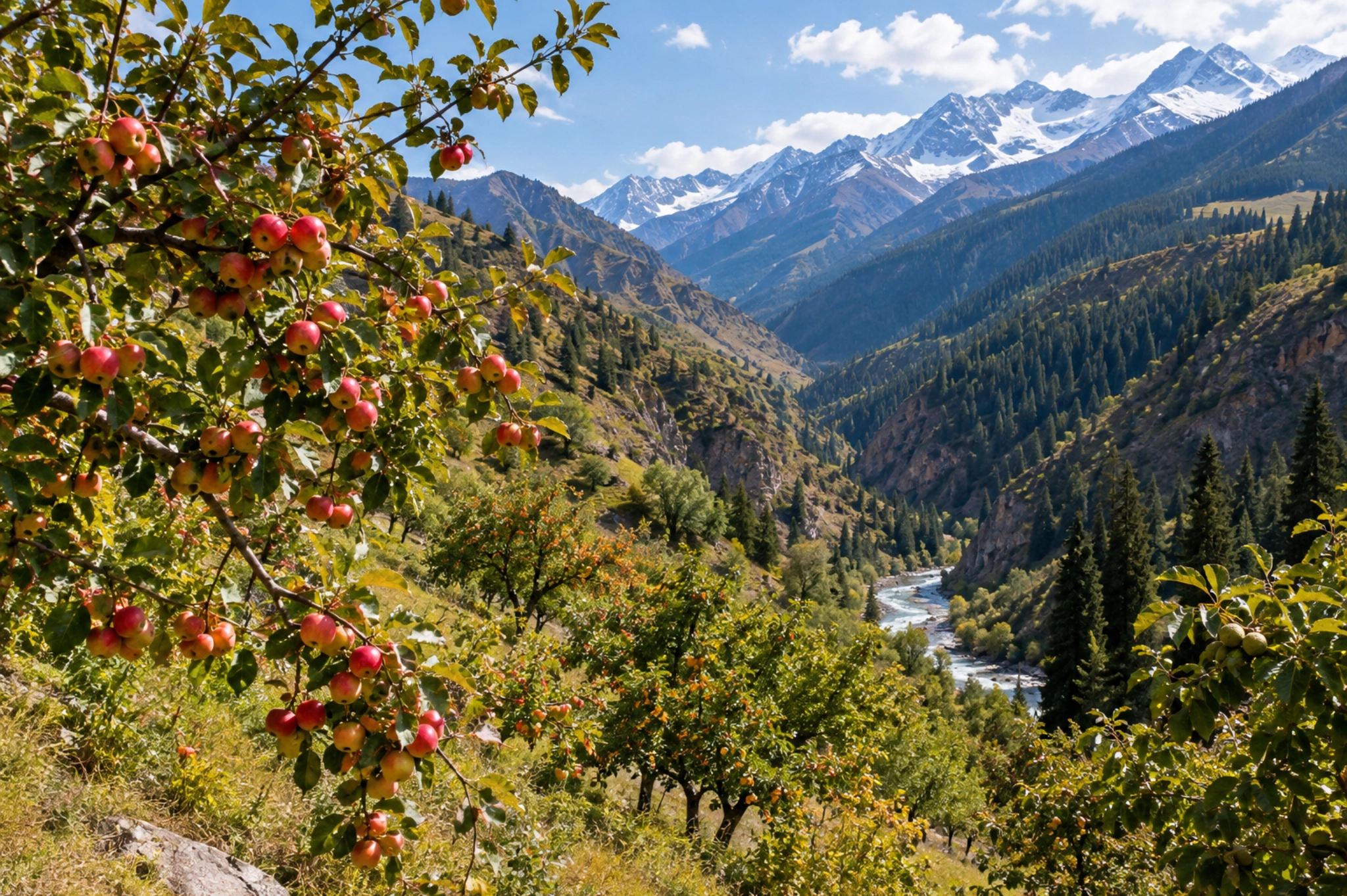
Guozigou is a 28-kilometre gorge cutting across the Northern Tian Shan in Huocheng County, in the Ili Kazakh Autonomous Prefecture of far-western Xinjiang. Its name is no marketing invention: the slopes here are covered in genuinely wild orchards — wild apples, apricots and walnuts growing untended across the mountainsides, threaded with dark ranks of Schrenk's spruce.
Those apples matter more than they look. The wild apple of the Tian Shan, is now understood by botanists to be the ancestor of nearly every domestic apple eaten on Earth. The valleys of Ili are one of the plant's last great strongholds, so to walk beneath these gnarled, fruit-heavy trees is to stand at the genetic source of the apple itself — an ordinary fruit with an extraordinary origin, growing wild exactly where the Silk Road ran.
The Autumn That Sets the Valley Alight
Guozigou is lovely for much of the year, but autumn is its masterpiece. From mid-September into October, as the first cold nights arrive, the wild fruit forests turn gold and amber while the spruces hold their deep emerald, and the two colours interleave up every slope in the richest, most layered palette the valley produces all year. Mist pools in the folds of the gorge at dawn; the low autumn sun rakes across the ridges; and the whole 28 kilometres becomes a slow, unfolding gallery of colour. It is the same golden-autumn window that draws photographers to Kanas and Hemu in the north — but here it comes wrapped around a mountain pass rather than a lake, and far fewer foreign travellers know to look for it.
The Bridge That Made the Pass Famous
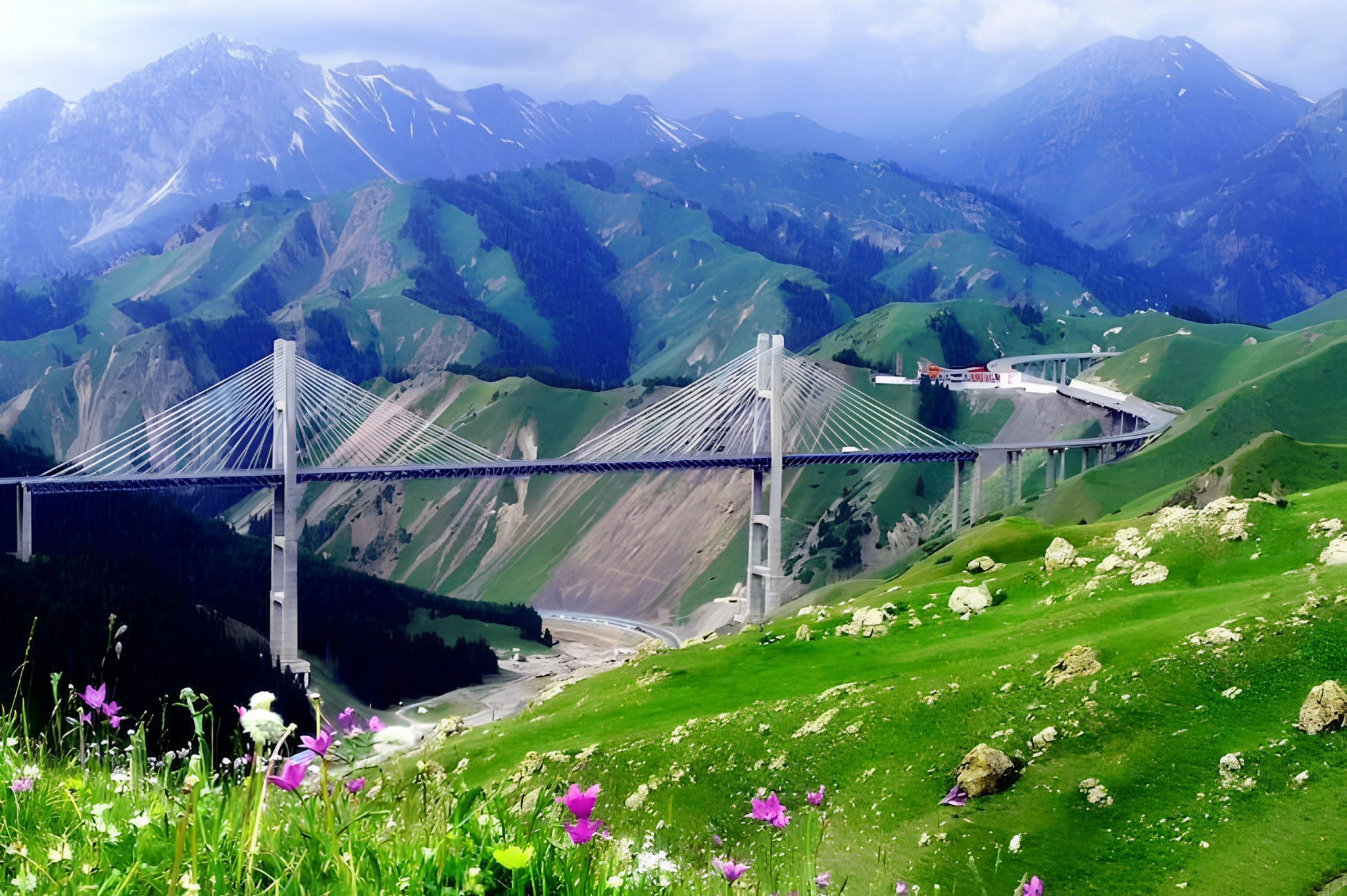
For most of its history Guozigou was famous only for being difficult. Today it is famous for the Guozigou Bridge — a double-tower, cable-stayed span roughly 700 metres long, its deck standing around 200 metres above the valley floor. Carrying the G30 expressway that links Ürümqi with the Ili Valley, it was a genuine feat of mountain engineering: rather than clawing down into the gorge in endless switchbacks, the road now simply flies across it.
The result is one of the great road-trip images of China — a silver bridge threaded between green peaks, with the fruit forests falling away beneath. The best views are not from the bridge itself (where you are on it and cannot see it) but from the viewpoints and the old highway that wind through the valley below and alongside, where you can stop, look up, and take in the full scale of the span against the mountains. Guozigou, locals like to say, was once famous for its fruit and is now famous for its bridge — but the truth is you come for both.
A Pass That Changed History
Long before the steel arrived, Guozigou was one of the most strategically important passes in Central Asia. For centuries the Northern Tian Shan formed a wall between the steppe and the Ili Valley, and Guozigou was the door through it. The route as a wheeled road is traditionally credited to the Mongol era of the 13th century, when the pass was opened up to move armies and caravans between the grasslands of Central Asia and the oases beyond — part of the northern route of the Silk Road that carried trade, faith and empire east and west.
Every caravan, envoy and pilgrim bound for Ili from the north once had to thread this single green gorge — which is why a valley of wild apples ended up mattering to the history of a continent.
Sayram Above, Ili Below
Part of Guozigou's magic is its position between two very different worlds. Climb to its northern end and you arrive almost immediately at Sayram Lake— the vast, sapphire-blue alpine lake known as "the last tear of the Atlantic," sitting high and cold above the treeline. Descend to its southern end and the land opens into the Ili Valley, the greenest, gentlest corner of Xinjiang, sometimes called the "Switzerland of Xinjiang," with the old city of Yining (Ghulja), lavender fields, Kazakh pastures and river grasslands. Guozigou is the hinge between them: in the space of an hour's drive you pass from high blue lake, down through a golden fruit gorge, into a soft green valley. Few road journeys anywhere pack so much change into so short of a distance.
How to Visit
Guozigou is experienced mostly as a drive rather than a single ticketed attraction, which makes it easy to fold into a Northern Xinjiang / Ili loop. Almost every itinerary that pairs Sayram Lake with Yining and the Ili Valley passes straight through the gorge, so the classic approach is to travel between the two and build in stops at the viewpoints for the bridge and the autumn forest. From Ürümqi it is a long but scenic drive west; many travellers break the journey at Sayram Lake and drop down through Guozigou into Ili the next day.
For the autumn colour, aim for late September to mid-October, and give yourself unhurried time on the old road for photographs — the light on the fruit forests is best in the golden hours. Because the highlights are strung along a mountain pass with fast expressway traffic, a local driver who knows the safe stopping points is far more comfortable, and far safer, than trying to pause on the highway yourself.
Travel Gently Through a Living Orchard
Guozigou is not a manicured park; it is a working mountain landscape of wild forest and Kazakh grazing land. Keep to viewpoints and paths, don't strip fruit or branches from the wild trees (they are a rare botanical treasure, not a free harvest), give herders and their animals room, and carry out everything you bring in. Buy honey, dried fruit and a meal from the families who live along the valley, and experience the same hospitality that has met travellers at this pass for eight centuries.
Most people cross Guozigou at speed, eyes on the bridge, and never stop. Give it an autumn afternoon instead — apples gold on the slopes, spruce dark between them, a silver span floating overhead — and you will understand why this single green gorge has been the gateway to Ili for as long as anyone has been travelling the Silk Road.