Navigating entry requirements for the People's Republic of China requires a precise understanding of immigration protocols updated by the National Immigration Administration (NIA). Whether traveling for leisure, international trade, or transit, selecting the wrong entry mechanism can lead to boarding denials, immigration detention, or deportation.
This detailed comparative guide evaluates the three primary entry pathways: the 240-Hour Visa-Free Transit, the unilateral/bilateral 30-Day Visa-Free Policy, and the Standard L Tourist Visa, highlighting strict geographic boundaries, allowed regions, and mandatory permit requirements.
Quick Comparison Matrix
| Feature / Criteria | 240-Hour Visa-Free Transit | 30-Day Visa-Free Policy | Standard L Tourist Visa |
| Max Stay Duration | Up to 240 Hours (10 Days) | Up to 30 Days | 30–90 Days per entry |
| Route Eligibility | Strict ABC Rule (Country A → China → Country C) | Any route (Direct round-trip allowed) | Any route (Direct round-trip allowed) |
| Port of Entry | Designated open ports across 24 provinces | All open international ports | All open international ports |
| Geographic Scope | Restricted to designated transit clusters across 24 provinces | Nationwide (Except special permit zones) | Nationwide (Except special permit zones) |
| Tibet Entry Allowed? | ❌ Strictly Prohibited | ⭕️ Yes (Requires Tibet Travel Permit) | ⭕️ Yes (Requires Tibet Travel Permit) |
| Xinjiang Entry Allowed? | ❌ Strictly Prohibited | ⭕️ Yes (Unrestricted general areas) | ⭕️ Yes (Unrestricted general areas) |
| Application Process | Issued upon arrival at border control | Direct entry via passport control | Advance consular application / VAC processing |
Deep Dive: 240-Hour Visa-Free Transit Policy
The 240-Hour Visa-Free Transit scheme caters to international travelers transiting through Mainland China en route to a third country or region.
The ABC Routing Rule (Mandatory Framework)
To qualify for the 240-hour permit upon arrival, your flight itinerary must strictly follow an A → B → C geographical sequence:
- Point A: Country/Region of origin (e.g., Singapore - SIN)
- Point B: Designated entry port in China (e.g., Shanghai - PVG)
- Point C: Third country/region of destination (e.g., United Kingdom - LHR)
Critical Immigration Notice: Hong Kong (HKG), Macau (MFM), and Taiwan (TPE) are categorized as independent third regions for immigration transit purposes. A non-stop round-trip itinerary (e.g., Los Angeles → Beijing → Los Angeles) violates the transit rule and will result in denied boarding at the point of origin.
Pros
- Zero Consular Fees: Eliminates embassy submission fees and service charges.
- Streamlined Processing: Permits are processed at designated immigration counters upon arrival.
- 10-Day Operational Window: Provides adequate time for short-term corporate meetings or regional tourism.
Cons
- Fixed Itinerary Requirements: Passengers must present confirmed onward tickets with allocated seats within 240 hours.
- High Carrier Liability: Airlines strictly audit transit itineraries prior to departure. Minor routing ambiguities result in immediate refusal to carry.
Geographic Boundaries: Allowed vs. Forbidden Regions for 240-Hour Transit
A common pitfall under the 240-hour transit policy is assuming it allows unrestricted travel across China. In reality, travelers must remain strictly within the 24 designated provinces/regions and their specific port clusters. Moving outside these permitted boundaries without a standard visa is illegal.
🟢 Allowed Regions & Travel Clusters (24 Provinces/Municipalities)
- Beijing-Tianjin-Hebei Cluster: Beijing, Tianjin, Hebei Province.
- Jiangsu-Zhejiang-Shanghai-Anhui Cluster: Shanghai Municipality, Jiangsu Province, Zhejiang Province, Anhui Province.
- Guangdong Cluster: Entire Guangdong Province (includes entry via Guangzhou Baiyun Airport, Shenzhen, and Hong Kong-Zhuhai-Macao Bridge ports).
- Sichuan Province: Entire province, including Chengdu.
- Shaanxi Province: Entire province, including Xi'an.
- Hubei Province: Entire province, including Wuhan.
- Fujian Province: Entire province, including Xiamen and Fuzhou.
- Hainan Province: Island-wide travel within Hainan.
- Chongqing Municipality: Chongqing municipal boundaries.
- Yunnan Province: Entire province, including Kunming and Lijiang.
- Other Approved Provinces/Areas: Shandong, Henan, Hunan, Guizhou, Liaoning, Heilongjiang (entire provinces); Jiangxi (Nanchang and Jingdezhen only); Shanxi (Taiyuan and Datong only); Guangxi (12 cities: Nanning, Liuzhou, Guilin, Wuzhou, Beihai, Fangchenggang, Qinzhou, Guigang, Yulin, Hezhou, Hechi, Laibin).
🔴 Completely Excluded
Any part of mainland China outside these 24 specific provincial jurisdictions is off-limits during a 240-hour transit stay.
Deep Dive: 30-Day Visa-Free Policy
Unilateral and bilateral 30-day visa exemption agreements allow passport holders of designated qualifying nations to enter China without prior consular approval.
Operational Scope
Travelers entering under the 30-day exemption can conduct business, tourism, family visits, and transit activities. The entry count is unconstrained, provided total stays remain compliant with individual country agreements.
Pros
- Complete Routing Flexibility: Direct round-trip flights are fully permitted.
- Nationwide Travel Access: Movement across provinces is unrestricted, excluding regions requiring specialized state security clearances.
- Spontaneous Travel: Removes documentation lead times, enabling immediate booking and travel.
Cons
- Non-Extendable: The 30-day duration cannot be extended inside Mainland China except under documented force majeure or medical emergencies processed by the local Public Security Bureau (PSB) Exit-Entry Administration.
- Restricted Purpose of Stay: Formal study, employment (Z-visa activities), or credentialed journalism remain strictly prohibited under visa-free entry.
Deep Dive: Standard L Tourist Visa
The L-type tourist visa remains the formal mechanism for non-exempt passport holders, extended stays, or multi-destination itineraries spanning over 30 days.
Application Mechanics
Applicants must submit biometric data, accommodation confirmations, daily itineraries, or official invitation letters through a China Visa Application Service Center (CVASC) or Chinese Embassy prior to departure.
Pros
- Extended Duration & Multiple Entries: Single, double, or multiple-entry visas valid for up to 10 years (subject to bilateral arrangements, such as US/Canadian passport standards).
- Comprehensive Territorial Access: Serves as the official foundation for securing secondary internal travel permits.
Cons
- Administrative Lead Time: Requires several business days for standard processing, alongside biometric submission.
- Financial and Documentation Overhead: Requires verified travel itineraries, bank statements (if requested), and non-refundable processing fees.
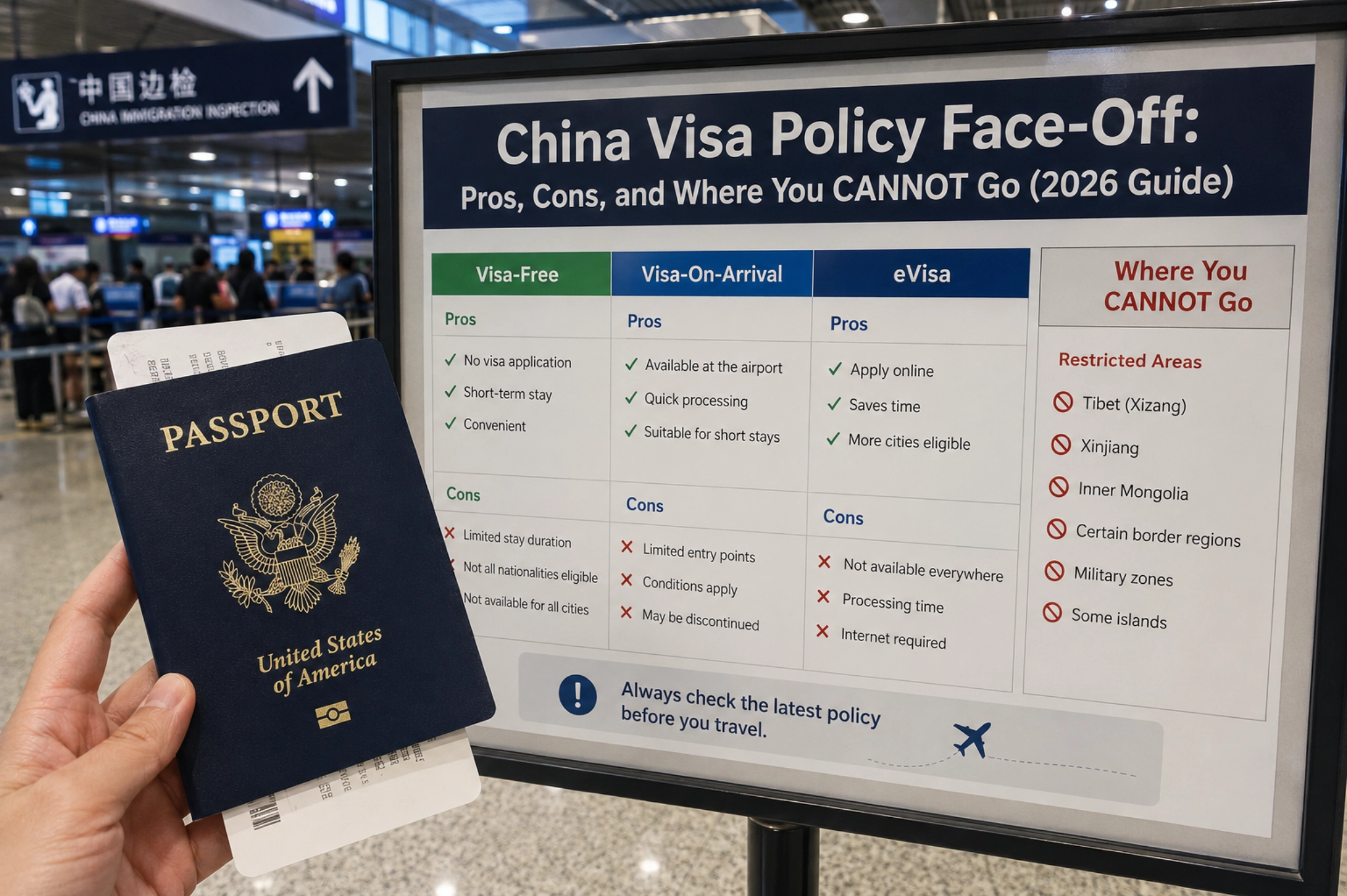
Restricted Zones: Where You CANNOT Go Without Special Clearances
Holding a valid entry status (Visa or Visa-Free) does not grant absolute access to all territories within China's national borders.
| Location | Entry Status | Special Permit Needed |
| Tibet Autonomous Region (TAR) | Visa / 30-Day Visa-Free | Tibet Travel Permit (TTP) Required |
| Tibet Autonomous Region (TAR) | 240-Hour Transit | ❌ Entry Forbidden |
| Xinjiang (General Cities) | Visa / 30-Day Visa-Free | None |
| Xinjiang (Border Prefectures) | Visa / 30-Day Visa-Free | Alien's Travel Permit / Border Pass |
| Military & Border Security Zones | All Statuses | Military Clearance Required |
Tibet Autonomous Region (TAR)
- Prohibition Under 240-Hour Transit: Travelers under the 240-hour transit scheme are strictly barred from entering TAR.
- Mandatory Documentation: Holders of 30-day visa-free entries or L visas must obtain an official Tibet Travel Permit (TTP) issued by the Tibet Autonomous Region Tourism Bureau. Independent travel in TAR is illegal; travelers must be booked on an organized tour with a licensed local guide.
Xinjiang Uyghur Autonomous Region
- Geographic Limitations: General cities (Urumqi, Kashgar, Turpan) are accessible under 30-day visa-free and tourist visa entries. However, 240-hour transit travelers cannot enter Xinjiang as it falls outside the designated transit containment zones.
- Border Area Restrictions: Traveling to sensitive border regions within Xinjiang (e.g., Tashkurgan near the Pakistan/Tajikistan border) requires a Border Pass and an Alien's Travel Permit issued by local Public Security Bureaus.
Military and Border Security Zones
Certain scenic areas located near defense installations or national borders (e.g., specific sectors of Mount Kailash, parts of Nyingchi, and military-managed maritime zones) are closed to foreign passport holders regardless of visa status.
FAQ
Q1: Can I book a round-trip ticket from London to Beijing and use the 240-Hour Visa-Free Transit?
Answer: No. A round-trip flight (London → Beijing → London) violates the mandatory ABC routing rule of the 240-hour transit policy. The itinerary must proceed to a third country or region (e.g., London → Beijing → Hong Kong (even as a short layover) → London) to be legally classified as a transit stay by China Immigration Inspection.
Q2: What happens if I overstay my 240-hour transit or 30-day visa-free allowance?
Answer: Overstaying violates the Exit and Entry Administration Law of the People's Republic of China. Penalties include administrative fines of 500 RMB per day (up to 10,000 RMB), administrative detention for 5 to 15 days, deportation, and a potential 1-to-5-year ban from re-entering China.
Q3: Is a Tibet Travel Permit (TTP) required if I enter China under the 30-day visa-free policy?
Answer: Yes. The 30-day visa-free policy exempts you from a standard entry visa but does not bypass administrative security regulations for restricted regions. Foreign passport holders must secure a TTP through an authorized Chinese travel agency prior to boarding flights or trains bound for Lhasa.
Q4: Can I extend my 30-day visa-free stay inside China if I want to stay longer?
Answer: Generally, no. The 30-day visa-free entry cannot be converted or extended under normal circumstances. If you require additional time for legitimate emergency reasons (such as hospitalization), you must apply for a Humanitarian Visa (L/Exit Permit) at the local Public Security Bureau Exit-Entry Administration before your 30 days expire.
Q5: Do Hong Kong and Macau count as third destinations under the 240-Hour Transit rule?
Answer: Yes. For immigration and border control operations, Hong Kong and Macau are recognized as independent port destinations. An itinerary such as San Francisco → Guangzhou → Hong Kong → San Francisco fully satisfies the 240-Hour Visa-Free Transit criteria.
Q6: Are biometric registrations (fingerprints) required for visa-free entries upon arrival?
Answer: Yes. All foreign national passport holders aged 14 to 70 entering China must submit biometric data (ten-fingerprint scan and facial recognition) at international ports of entry, unless covered by specific diplomatic or bilateral exemption agreements.