S ome travel destinations force you to choose between breathtaking natural landscapes and deep historical immersion. Gansu refuses to compromise. This long, crescent-shaped province in China's northwest defines the Hexi Corridor—the narrow, fertile strip of life squeezed between the freezing peaks of the Qilian Mountains and the unforgiving sands of the Gobi Desert. For thousands of years, this geographic choke point funneled every diplomat, monk, soldier, and merchant caravan traveling along the ancient Silk Road between imperial China and the Western world.
In 2026, the Hexi Corridor has emerged as the premier independent overland loop in East Asia. Thanks to high-speed rail integration and optimized international transit rules, foreign travelers are experiencing these ancient gateways with unprecedented ease. Here is how to navigate Gansu's legendary terrain safely, efficiently, and with maximum reward.
The 2026 Travel Advantage
240-Hour Visa-Free Transit
The biggest barrier to exploring Western China has traditionally been the paperwork required for a standard tourist visa. However, in 2026, China’s 240-hour (10-day) visa-free transit policy is making it easier than ever for international visitors to access key destinations in the region as part of organized itineraries and guided group tours.
If your home country is on the approved list and you possess an onward ticket to a third international destination (such as flying from London to Xi'an, completing the Gansu loop, and flying onward to Taipei), you can enter without a standard visa. Xi'an and Lanzhou serve as fully approved entry, exit, and transit ports for this system, turning a once-complex bureaucratic headache into a streamlined border crossing.
— ALONG the CORRIDOR
Stop 01
Zhangye Danxia
The technicolor mountains that defy belief
Your first major overland stop brings you to a landscape that looks entirely digital. The Zhangye Danxia landform is an expansive geological park of jagged valleys and undulating ridges streaked with vibrant bands of terracotta crimson, rich amber, jade green, and deep lavender. This multi-coloured wave effect is the product of over 24 million years of red sandstone and mineral deposits settling layer by layer, later buckled by tectonic shifts and sculpted by wind and rain. Celebrated at the 74th Venice Film Festival and recognized as a premier global geographical wonder, the park uses wooden boardwalks and zero-emission shuttle buses linking four elevated viewing platforms to protect the delicate sandstone crust from erosion.
THE SECRET TO PHOTOGRAPHING DANXIA
Lighting changes everything. Do not visit at noon — intense overhead sun flattens the minerals, making the mountains look like pale pastel chalk. Schedule your entry for the golden windows of sunrise or late sunset.
And if a passing summer rain shower catches you, don't leave: water saturation instantly deepens the mineral hues, making the colours pop with surreal intensity.
Stop 02
The Mogao Caves
A secret vault of ancient history in Dunhuang
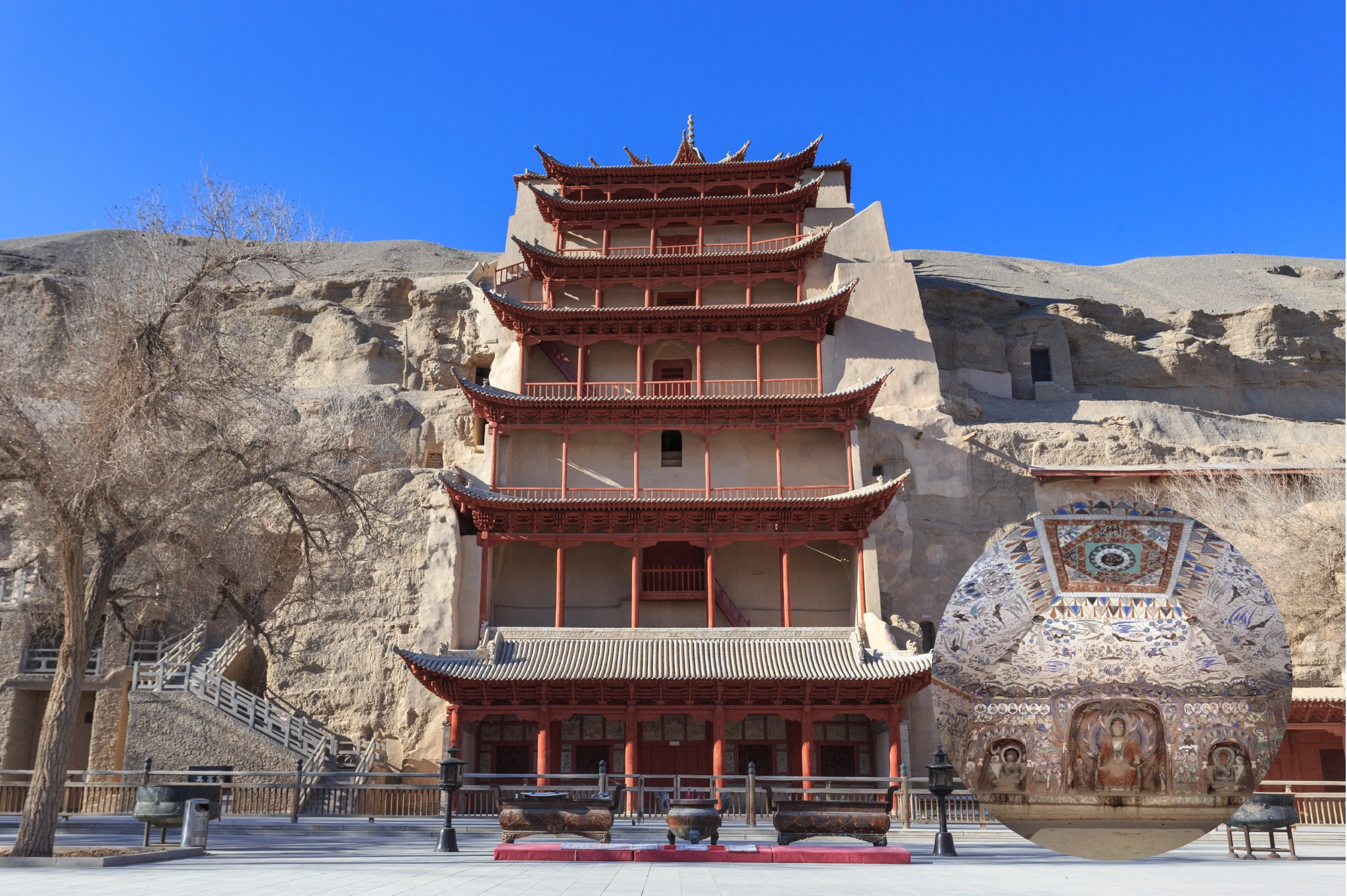
While Zhangye provides the visual spectacle, the oasis city of Dunhuang is the spiritual and cultural soul of the Silk Road. For over a millennium, Dunhuang was the final point of comfort before westbound travellers faced the deadly Gobi and Taklamakan deserts. Grateful for survival or terrified of the journey ahead, wealthy merchants, royals, and devout monks carved a sprawling subterranean sanctuary into the sandstone cliffs. The UNESCO-listed Mogao Caves consist of 492 surviving cave temples carved continuously between the 4th and 14th centuries. Protected by hyper-arid desert air, the interiors safeguard tens of thousands of square metres of brilliant Buddhist murals and thousands of hand-painted clay sculptures — the world's most complete and uninterrupted visual record of the evolution of medieval Central Asian art, cross-pollinated by Chinese, Indian, Persian, and Greco-Buddhist styles.
2026 MOGAO BOOKING REQUIREMENTS
The Mogao Caves can't be visited on a walk-up basis. To limit the humidity and carbon-dioxide damage that visitors' breath inflicts on the ancient murals, daily entries are strictly capped and managed through computerized timed slots.There's an added catch for foreign visitors: the convenient online booking system is reserved for Chinese citizens and residents. Only a small daily allotment is held at the on-site ticket office for foreign passport holders — and in peak season it sells out fast, with no guarantee of an English-language guided slot. Securing entry well in advance through a recognized foreign-affairs travel agency is the reliable way in, locking in both your timed entry and an English-speaking guide — which is exactly what we arrange for you.
Stop 03
Mingsha Shan & Crescent Lake
Where the singing sands meet the ancient oasis
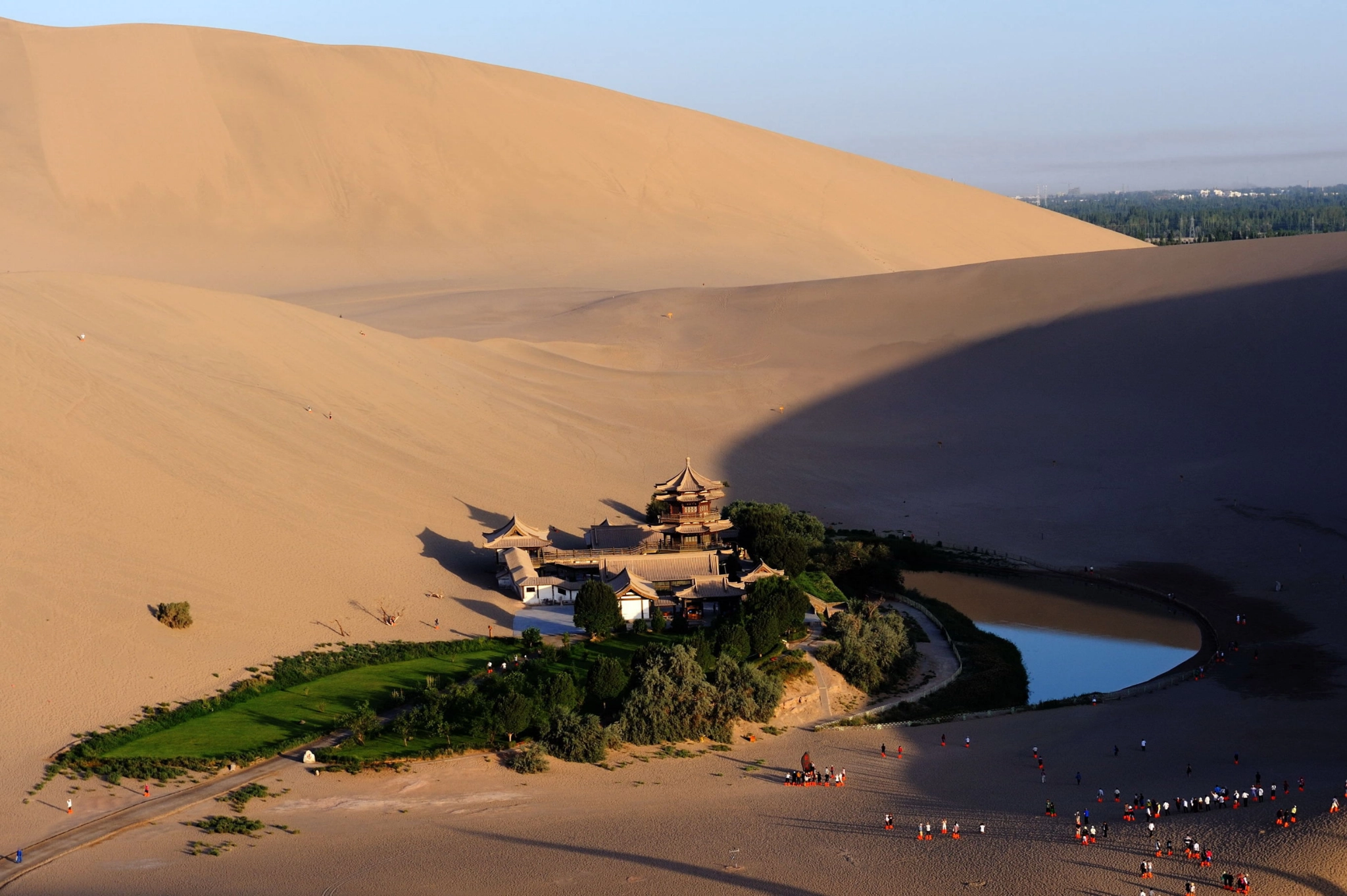
Directly outside Dunhuang lies Mingsha Shan ("Singing Sand Mountain"), an immense wall of towering desert dunes that produces a low-frequency harmonic humming or roaring sound when high winds shift the sand particles or when visitors slide down the steep slopes.
Nestled impossibly at the absolute base of these massive dunes is Crescent Lake (Yueyaquan). This naturally occurring, crescent-moon-shaped spring of pure groundwater has miraculously defied desertification, remaining unburied by the shifting sands for over two thousand years. A traditional multi-tiered pagoda temple stands at its shore, creating one of the most iconic landscapes in all of Asia. For a classic experience, ascend the dune ridges via camel caravan at dusk to witness the sunset over the desert horizon.
Stop 04
Jiayuguan Pass
The edge of the known world
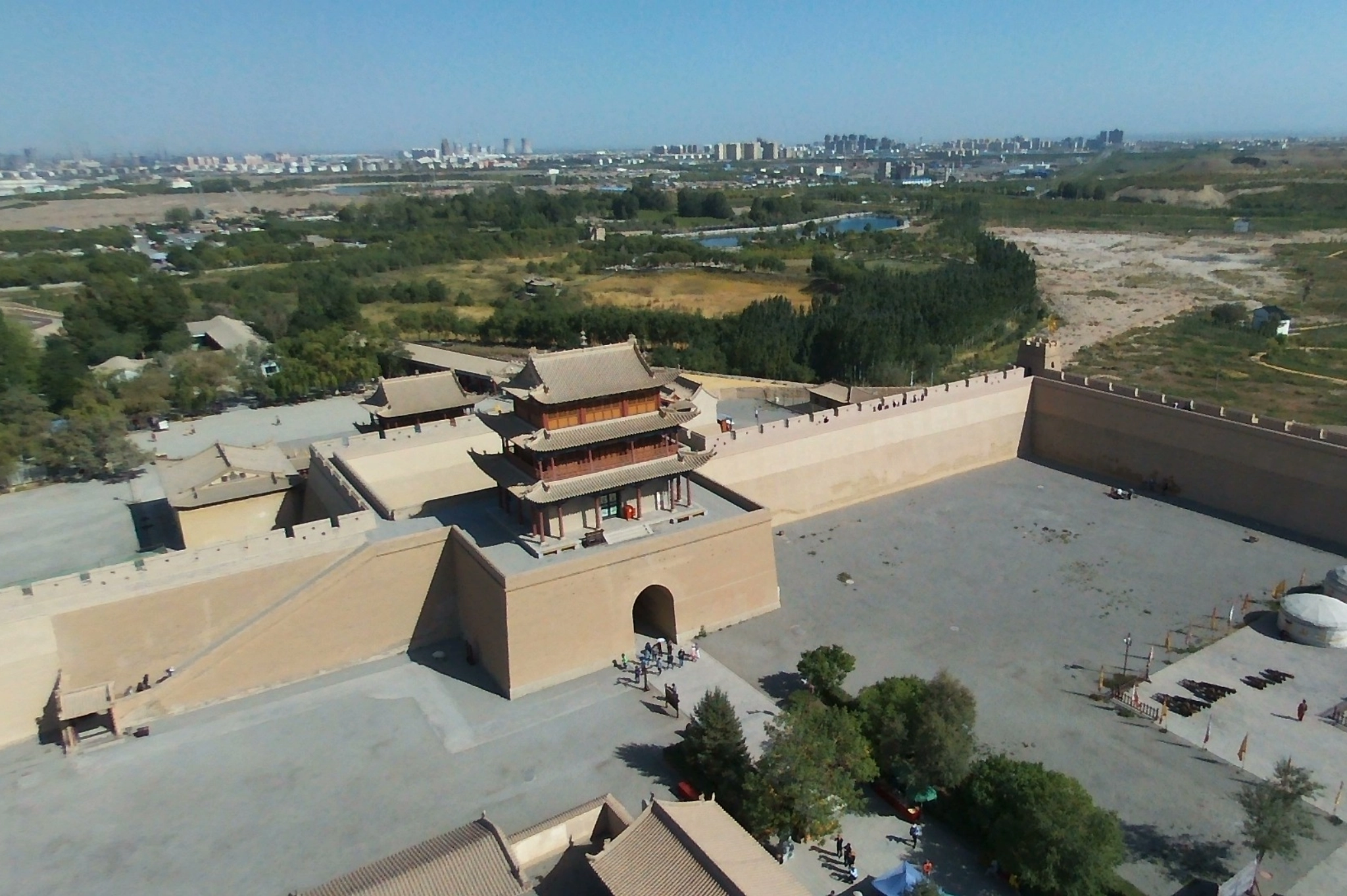
Connecting Zhangye and Dunhuang is Jiayuguan Pass, the military punctuation mark of the Hexi Corridor. Known historically as the "First and Greatest Pass Under Heaven," this massive trapezoidal mud-and-brick fortress is the definitive western terminus of the Ming Dynasty's Great Wall. For centuries this pass marked the absolute border of Chinese civilization — to step outside its western gate was to enter lawless exile, wild deserts, and unknown terrors. Standing on the high ramparts today, flanked by the snow-capped Qilian mountains on your left and the infinite gravel plains of the Gobi on your right, you can feel the immense isolation that ancient sentries endured.
— FAQ
Q1: Are the Danxia mountains a physically demanding hike?
Not at all. The entire scenic reserve is highly accessible for individuals of all fitness levels. Internal park shuttle buses transport you directly between the four primary viewing sectors. Once you exit the bus at a sector, you only need to walk up well-maintained wooden staircases and flat boardwalks to reach the panoramic vistas. Walking directly onto the multi-colored sand formations is strictly prohibited to prevent environmental destruction.
Q2: Can I link this loop directly with a trip into Xinjiang?
Yes, easily. The high-speed rail line runs directly through the Hexi Corridor and continues west over the provincial border into Xinjiang, stopping at major hubs like Turpan and Urumqi. Combining Gansu and Xinjiang via the bullet train system forms the ultimate, low-stress overland Silk Road adventure across Northwest China.