China's Most Expensive Seafood Sleeps Through the Summer, Dissolves If You Upset It, and Is Picked by Hand by Divers Thirty Metres Down — and Shandong Is Its Capital
Walk into a serious restaurant in Weihai, Yantai or Qingdao, open the menu, and look for the dish where the price stops making sense.
Everything else on the page is priced like food. Then there is one item — often two or three characters, often with no photograph — that costs more than the rest of the table combined.
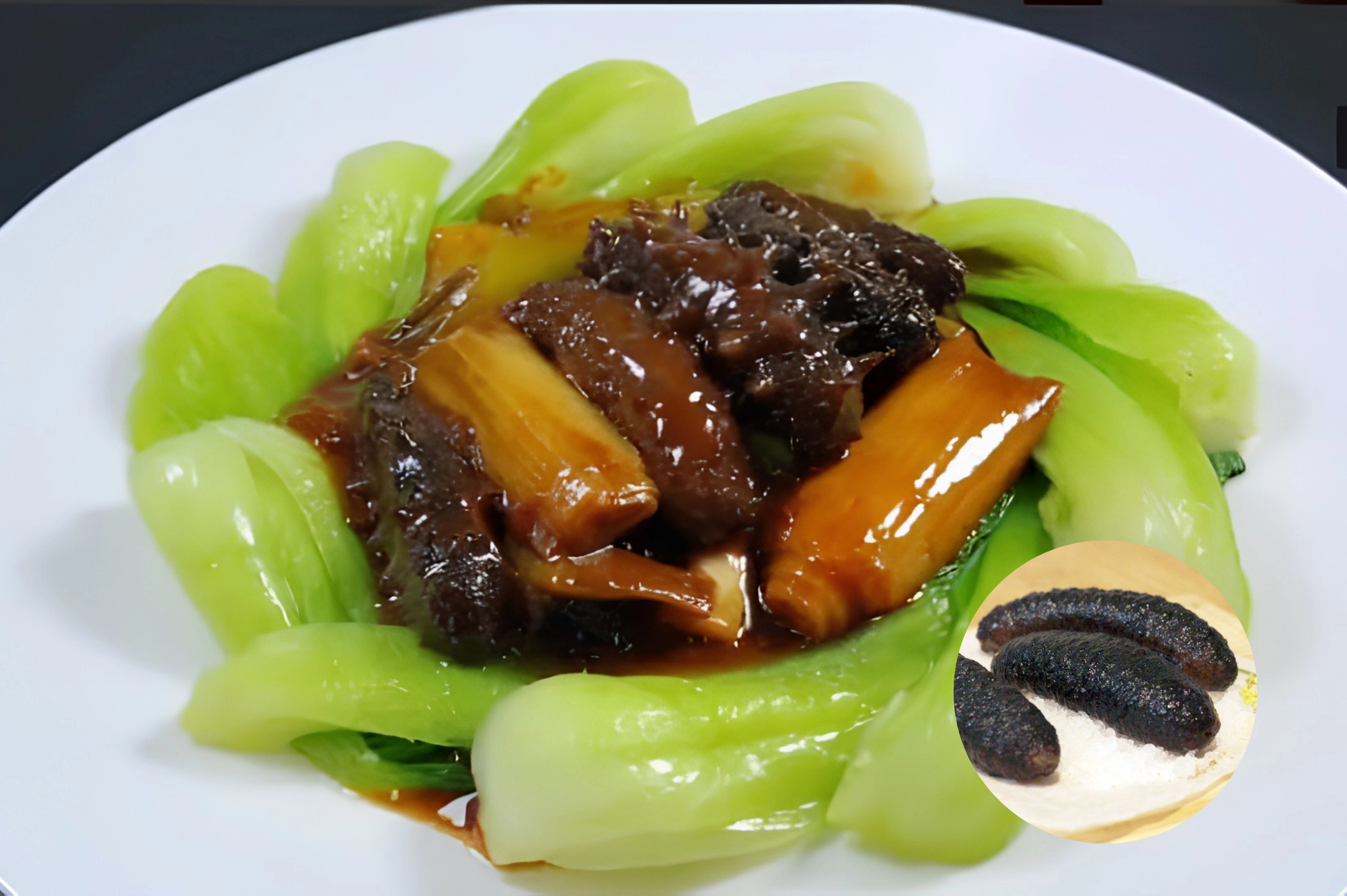
That is haishen. Sea cucumber. And in northern China it is not a curiosity or a dare. It is the top of the hierarchy: the ingredient that signals a host is taking the occasion seriously, the thing sent as a gift when the relationship matters, the dish by which a Shandong chef's entire reputation is judged.
The Chinese name is the first clue. Hai is sea. Shen is ginseng. The name means, in effect, the ginseng of the sea — which tells you at once that this was never understood primarily as a flavour. It was understood as a tonic, a rarity and a status object, and it has been an emblem of wealth and prosperity in China for almost a thousand years.
And the best of it in China comes from the stretch of cold, rocky, current-scoured seabed off the eastern tip of the Shandong Peninsula.
Meet the Animal, Because It Is Genuinely Strange
Before the food, the biology — because almost nobody tells visitors this, and it is the most interesting part.
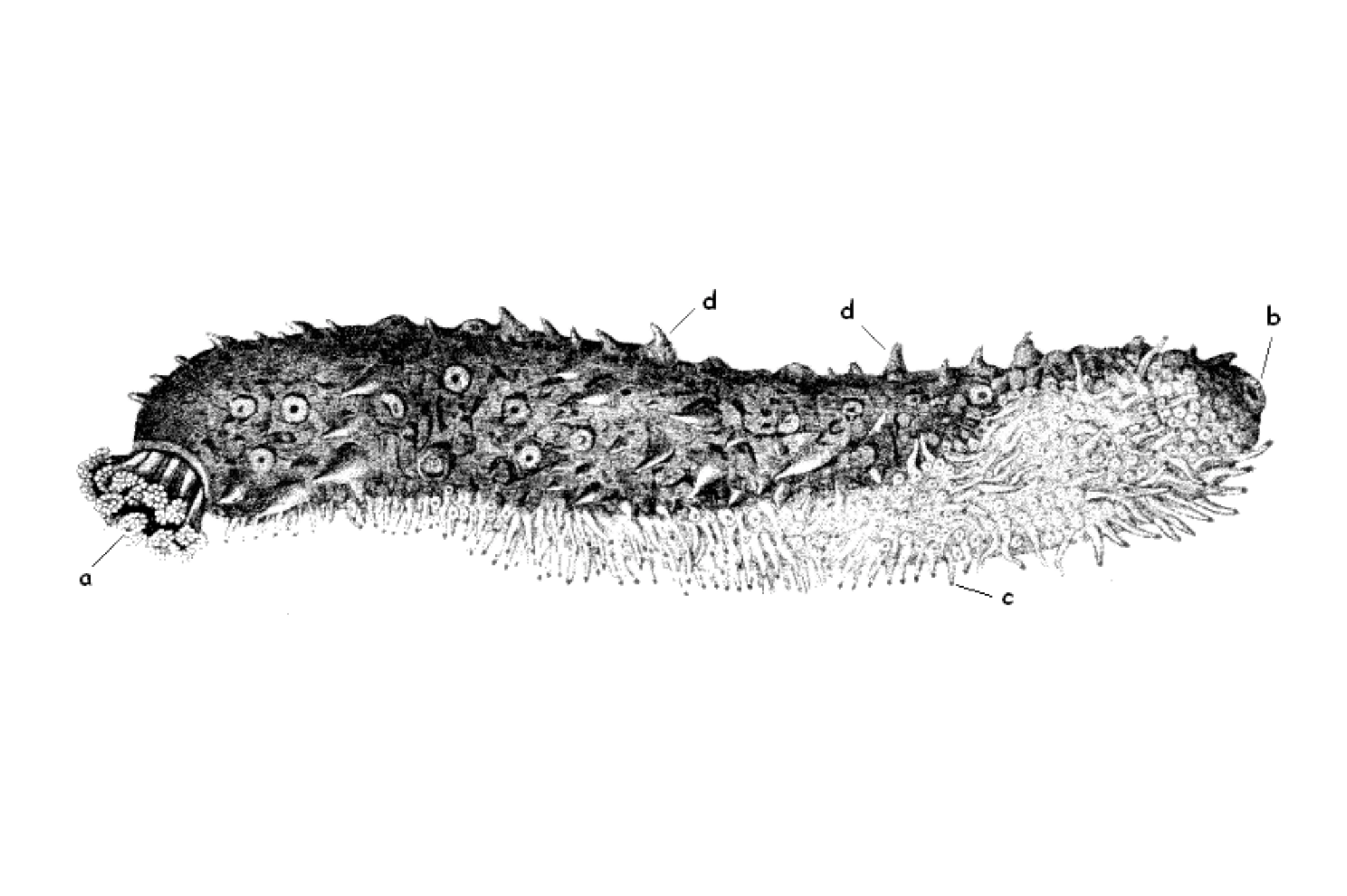
The species that matters here is Apostichopus japonicus, the spiny sea cucumber, known in Chinese as cishen — "thorn ginseng," for the rows of soft conical spines along its back.
It is an echinoderm: same phylum as starfish and sea urchins, not remotely a fish, not remotely a mollusc. It lies on the seabed and eats sediment, passing sand and organic detritus through its body and depositing it cleaned. There are ecosystems in which sea cucumbers are effectively the janitorial staff.
Four things it does that almost nothing else on a menu does:
- It hibernates in summer. When sea temperature climbs past roughly 20°C, the sea cucumber enters summer dormancy. It stops feeding, shrinks, and lies dormant until the water cools. This is the single most important fact for anyone planning a trip around it. The animal is at its poorest in August and at its best in the cold months. Sea cucumber is a winter food because the sea cucumber says so.
- It can throw away its own internal organs. Under severe stress, a sea cucumber can eviscerate — expelling its gut and associated organs, sometimes as a defence that leaves a predator with a mouthful of viscera while the animal escapes. It then regenerates them. An animal that can regrow its digestive system is not a slug in any meaningful sense.
- Its body wall changes stiffness on command. Sea cucumbers have what biologists call catch connective tissue — collagen that can be locked rigid or released soft under nervous control. This is why the texture is so peculiar and so prized: the eating quality of a sea cucumber is a direct consequence of a tissue type that exists to let the animal wedge itself into a rock crevice and become immovable.
- It can dissolve. Handled badly, stressed, or left in warm or fresh water, a sea cucumber will begin to autolyse — its own enzymes break the body wall down until the animal effectively melts into liquid. This is not a metaphor. It is why sea cucumber is processed within hours of being landed, why the dried trade exists at all, and why the handling chain is as expensive as the harvest.
Put those together and you have an animal that sleeps through the warm half of the year, cannot be netted, cannot be trawled, cannot be stored alive for long, and destroys itself if mishandled.
There is no cheap way to get one. That is the whole price story.
Why Weihai and Yantai, Specifically
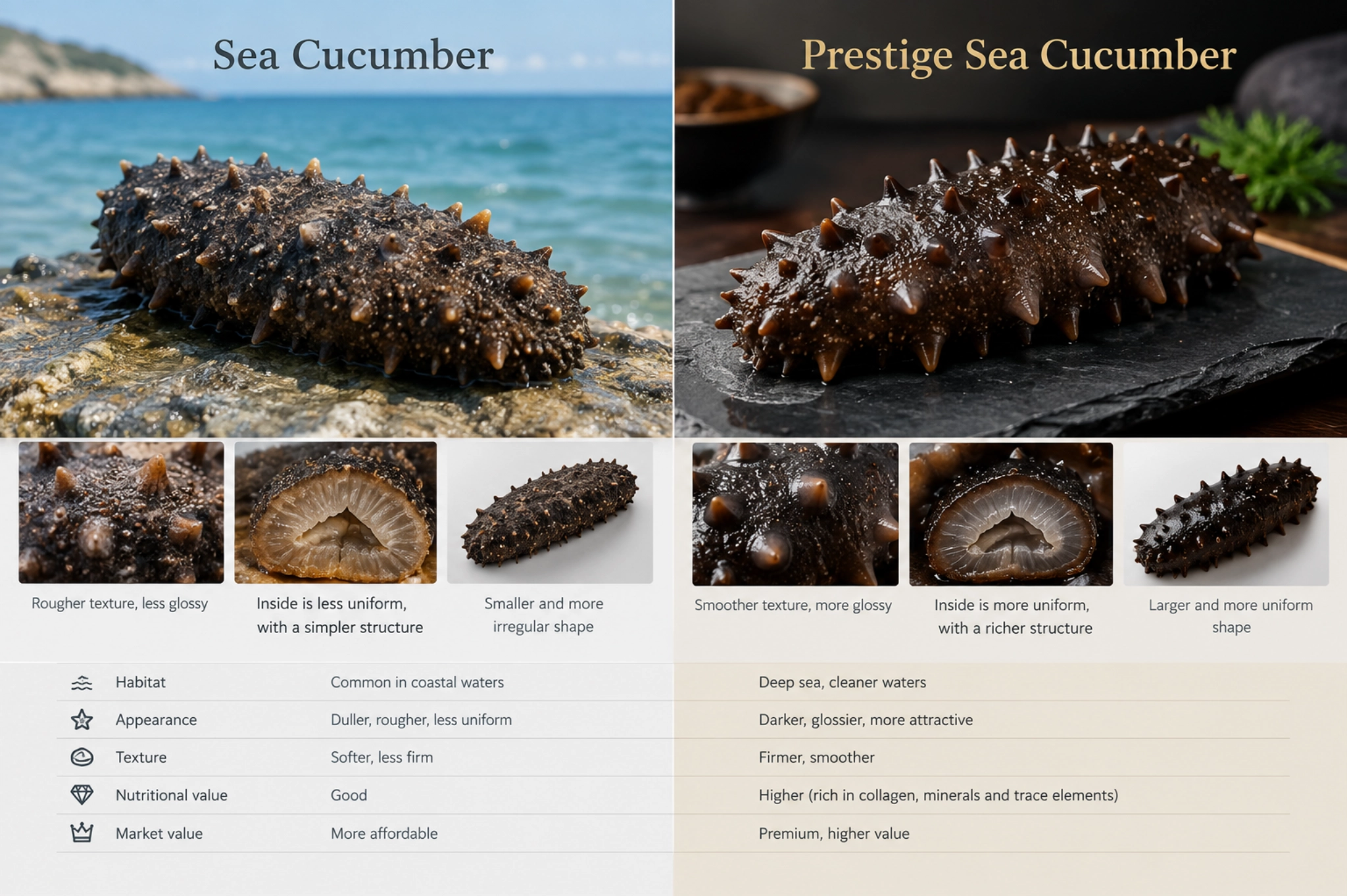
Sea cucumbers live all over the world. Prestige sea cucumbers do not.
The Shandong Peninsula's eastern coast — Weihai, Rongcheng, Yantai, and the island waters off Changdao — has an unusual combination:
- Cold winters, genuinely cold water: Slow growth; denser body wall; the spines that define grade.
- Rocky and reef seabed rather than soft mud: Better attachment, cleaner animal, classic bottom-grown character.
- Strong tidal exchange through the Bohai Strait: Constant water movement; firmer texture.
- Clean water and a long-regulated coastline: Weihai in particular built its reputation on water quality.
The result is a recognised regional hierarchy that Chinese buyers take extremely seriously. Weihai sea cucumber and Yantai sea cucumber are both protected China Geographical Indication products — the same legal mechanism that protects Champagne or Parma ham. Weihai has additionally been awarded national recognition as China's sea cucumber capital.
That distinction is not marketing gloss. In a market where a dried product's origin can multiply its price several times over, origin authentication is a live scientific field: Chinese researchers have published methods using trace-element analysis and DNA techniques specifically to distinguish dried sea cucumber from Weihai, Yantai and Qingdao from one another and from imports.
When a country is running machine-learning models on elemental signatures to tell one coastal county's sea cucumbers from the next county's, you are looking at something that functions economically more like wine than like seafood.
Bottom-Sown, Not Trawled: The Part Western Diners Need to Hear
Many Western readers know the words "sea cucumber" only from bad news — reef poaching, smuggling syndicates, collapsed tropical fisheries in the Indo-Pacific and East Africa.
Shandong's industry is a different animal, literally and structurally, and the distinction is worth having.
The dominant method here is bottom-sowing: juvenile sea cucumbers are raised in hatcheries and then released onto leased, managed patches of natural seabed, where they live and feed wild for several years before being harvested. It is closer to oyster ranching or reforestation than to reef stripping. There is also intensive pond culture at the cheaper end, and a small genuinely wild catch at the top.
The grades, roughly:
- Wild-caught: Naturally settled, harvested by divers. Rarest, most expensive, most variable.
- Bottom-sown: Hatchery juveniles grown out on open seabed for years. The prestige mainstream in Weihai and Yantai.
- Pond-raised: Enclosed coastal ponds, faster growth cycle. Volume market; visibly softer, fewer spines.
If you are being offered "wild Weihai sea cucumber" at a price that seems reasonable, it is bottom-sown — which is not a scandal and is in fact what most connoisseurs are actually buying. It simply means the words have drifted, the way "free range" has in the West.
Because harvest is by hand, one animal at a time, there is no bycatch, no seabed dragging and no habitat destruction in the operation itself. For travellers who think about these things — and more do every year — Shandong's sea cucumber is a comfortable order in a category that is often not.
The Divers
Here is the work itself, and it is the reason this article exists.
A sea cucumber cannot be netted. It sits on the bottom, often wedged among rocks and weed, and the only way to get it is for a person to go down and pick it up.
So they do. In the harvest season, divers off Weihai and the Rongcheng coast descend 20 to 30 metres to the seabed, working in weighted suits fed by surface air lines, and comb the bottom by hand and by feel, filling a net bag. They surface, empty it, and go down again. A single diver's shift is measured in bags.
And the season is precisely the worst time to do it. Because the animal is best when the water is coldest, the peak of this work lands as autumn turns to winter, in water temperatures that are brutal, on a coast where the north wind comes off the Bohai with nothing in its way.
This is one of the hardest and most dangerous forms of fishing work left on the Chinese coast. Repetitive deep diving carries decompression risk; cold water and long shifts compound it; visibility on a stirred-up seabed is often near zero.
It is worth holding that image when a small white plate arrives with three glossy dark cylinders on it and a price attached. Every one of them was picked up by a person's hand, in the dark, in cold water, in November.
How Shandong Actually Cooks It
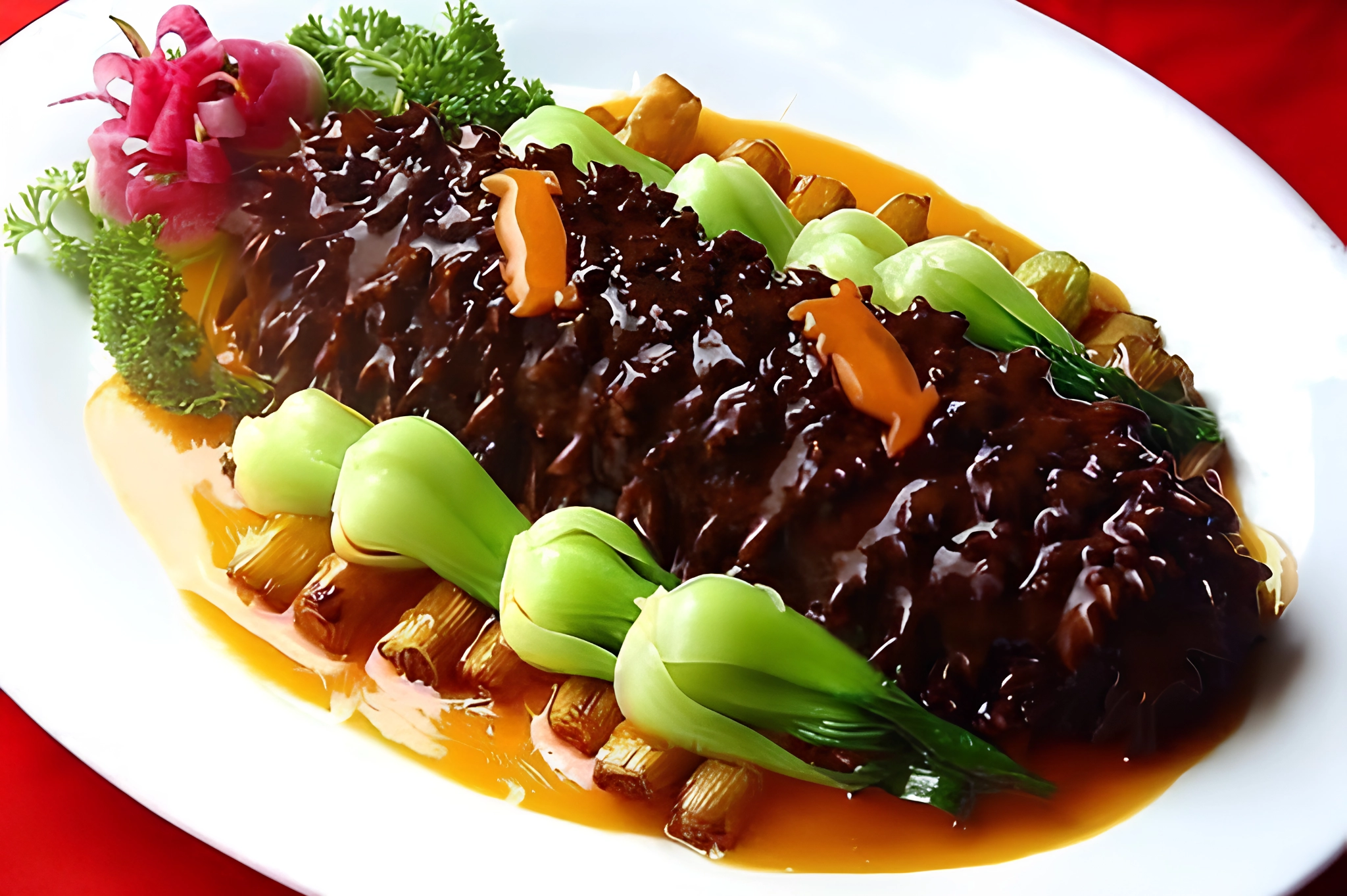
Sea cucumber has essentially no flavour of its own. This is not a failing; it is the entire premise. What it has is texture — slippery, springy, faintly crisp at the bite, then yielding — and an extraordinary capacity to absorb whatever it is cooked in.
Which makes it the ultimate test of a sauce, and therefore the ultimate test of a chef.
The dish: Cong shao hai shen — Sea Cucumber Braised with Scallions
Cong shao hai shen is the signature luxury dish of Lu cuisine, Shandong's culinary tradition and the oldest and most influential of China's eight great regional cuisines — the one that shaped imperial court cooking in Beijing and therefore much of what the world thinks of as "Chinese food."
The dish is deceptively plain to look at: dark glossy sea cucumbers in a mahogany sauce with lengths of scallion. What is actually happening:
- Scallion oil is made by slow-frying large quantities of Shandong scallions — including, in the best kitchens, the giant Zhangqiu scallions that grow taller than a person — until they surrender everything they have into the fat.
- A superior stock and soy-based braise is built around that oil, seasoned and reduced to a sauce that will coat.
- The rehydrated sea cucumber is braised until it has drunk the sauce, and the sauce is reduced until it clings without thickener doing the work for it.
There is nowhere to hide. No spice to mask a weak stock, no chilli to carry a flat sauce, no strong protein flavour to blame. Chefs in Shandong will tell you that you can judge a Lu kitchen on this one plate, and they are not exaggerating for effect.
The other ways you will meet it:
- Braised with scallion: The classic; every serious Lu restaurant.
- Sea cucumber with egg: Homely, delicious, far cheaper, and a much better introduction.
- In a breakfast congee or soup: Weihai and Yantai hotel breakfasts often include it — the local flex.
- "Ready-to-eat" vacuum packs: The gift and souvenir format; sold everywhere on this coast.
- Dried: The traditional trade form; requires days of soaking before cooking.
On the dried version, one warning worth giving plainly: rehydrating a dried sea cucumber is a genuine multi-day process involving repeated soaks in cold water, changes of water, gentle simmering, cleaning of the interior, and strict avoidance of oil and salt at the wrong stage. It is not a weekend project undertaken casually. If you are buying dried sea cucumber as a gift for someone who does not cook Chinese food seriously, buy the ready-to-eat packs instead. They exist precisely because the dried form defeats people.
The Tonic Question, Answered Honestly
Sea cucumber occupies a place in Chinese food culture alongside ginseng, bird's nest and cordyceps: the category of foods eaten as much for what they are believed to do as for how they taste. It is traditionally regarded as strengthening, restorative and appropriate for convalescents, the elderly, and anyone who has been working too hard — which is why autumn and winter, the traditional tonic seasons, are also the peak consumption and gifting months.
The honest position for a visitor: it is a high-protein, very low-fat food containing collagen and various marine compounds that have attracted genuine research interest. The traditional health claims made for it in the marketplace go considerably further than the evidence currently supports, and nothing here should be taken as medical advice.
Eat it because it is one of the defining textures of northern Chinese cooking and because you are on the coast that produces the best of it. That is a completely sufficient reason.
When to Go, and Where
The season:
- June–August: Summer dormancy. The animal is dormant and at its worst. Avoid if this is the point of the trip.
- September–October: Feeding resumes as water cools; quality climbing; the whole Shandong coast is in peak seafood mood.
- November–January: Peak. Cold water, best texture, the main diving harvest, and the start of gift season.
- March–May: The spring harvest window; very good, and considerably more comfortable weather.
For most travellers the sweet spot is late September through early November — the sea cucumber is coming good, the rest of the Shandong seafood calendar is at its absolute peak after the summer fishing moratorium lifts, the autumn weather on this coast is the best of the year, and you are not trying to sightsee in a January Bohai wind.
The places:
- Weihai: China's sea cucumber capital and one of the cleanest and most liveable small cities on the Chinese coast. Base here for the real experience. The city's seafood restaurants take sea cucumber seriously without the Qingdao markup, and the surrounding coast — Rongcheng, the seaweed-roofed villages, Chengshantou at the peninsula's tip — is the most under-visited beautiful coastline in eastern China.
- Rongcheng: The diving and processing heartland, plus Swan Lake, where thousands of whooper swans winter from roughly November. The swan season and the sea cucumber season are the same season. That is an unusually good pairing for a late-autumn itinerary.
- Yantai: The other GI-protected origin, the old treaty port of Chefoo, and the easiest of the three to combine with Penglai and the Changdao islands.
- Qingdao: Most travellers' entry point, and where most will actually eat it. Excellent restaurants, higher prices, and the pleasure of ordering it two hours' train ride from where it was picked up.
Practical notes for 2026:
- Getting there: Qingdao to Yantai is roughly 1 hour 10 minutes by high-speed rail; Yantai to Weihai is another short hop. The whole peninsula is comfortably a rail itinerary with no domestic flights required.
- Visa: Shandong is well covered by China's current visa-free and transit visa-free arrangements, including entry through Qingdao. Check the position for your nationality close to departure, as the policy has been expanding repeatedly.
- Buying to take home: ready-to-eat vacuum packs travel fine and are the sensible souvenir. Dried product is legal to carry in most jurisdictions but declare it; some countries restrict marine products on import. Check your own customs rules before you buy a gift box, not after.
- Ordering sensibly: if you want to try it without committing to a banquet plate, ask for sea cucumber with egg, or a breakfast congee version. You will learn the texture for a fraction of the price and can then decide whether to spend properly on cong shao hai shen later in the trip.
What This Actually Tells You About Shandong
Shandong's coast is where China eats. The province leads the country in fisheries and aquaculture, and the peninsula's list of one-product capitals is faintly ridiculous: Rushan grows oysters by the tonne per minute, Rongcheng roofs its houses in seaweed and harvests kelp, Zhaoyuan mines gold, Yantai grows the apples and makes the wine, Laiyang grows the pears, Zhangqiu grows the giant scallions, Shouguang supplies half a nation's vegetables.
Sea cucumber is the aristocrat of that list. It is the one that takes five years, cannot be mechanised, requires a person to go into cold water, and ends up on the most formal table in the room.
Understand it, and you understand why Shandong food has the reputation it does in China — not delicate, not showy, not spicy, but built on ingredient quality and stock-making of a seriousness that other cuisines simply assume rather than perform.
You do not have to like the texture. A fair number of first-time Western diners do not, at first. But you should sit in front of it once, on the coast it comes from, in the month it is best, and know what it took to get there.