
A Man From Chongqing Learned English Overnight, Chased a YouTuber Across Five Cities to Hand Him a Goose — and His County Sold 290,000 of Them in Five Days
In April 2025, a livestreamer from a western Chongqing district called Rongchang decided that the most useful thing he could do with his life that week was give a goose to an American teenager.
His name is Lin Jiang. He sells agricultural products online, and by his own account he had failed at seven businesses before this one. The American was IShowSpeed, one of the largest streamers on the planet, then midway through a live-broadcast tour of China that several hundred million people were watching.
Lin tracked the itinerary. He spent eight days crossing five cities. He taught himself English overnight using AI translation, practising on the bullet train to Chengdu, because there was one thing he absolutely had to be able to say to a foreigner about Rongchang braised goose and he could not risk getting it wrong:
"Not spicy."
He caught up with the tour in Chengdu. The clip went everywhere. Videos tagged with the dish were doing over 100 million views a day. And then something happened that almost never happens to a regional Chinese speciality: the internet attention turned into a queue.
Over the five-day May Day holiday that followed, Rongchang sold 290,150 braised geese in physical shops — a 752% increase on the same period the previous year, with 40% of them bought by visitors from outside the district. On 2 May alone, shops moved roughly 30,000 geese over the counter and another 20,000 online: about 50,000 geese in a single day. Rongchang's tourism traffic rose 157% year on year. The district government building became a check-in spot.
Lin Jiang, asked repeatedly whether he was cashing in, gave the line that ended up in every Chinese newspaper:
"Traffic will leave. But Rongchang braised goose has to stay."
He does not own a braised goose shop.
First, the Thing That Surprises Every Foreign Visitor
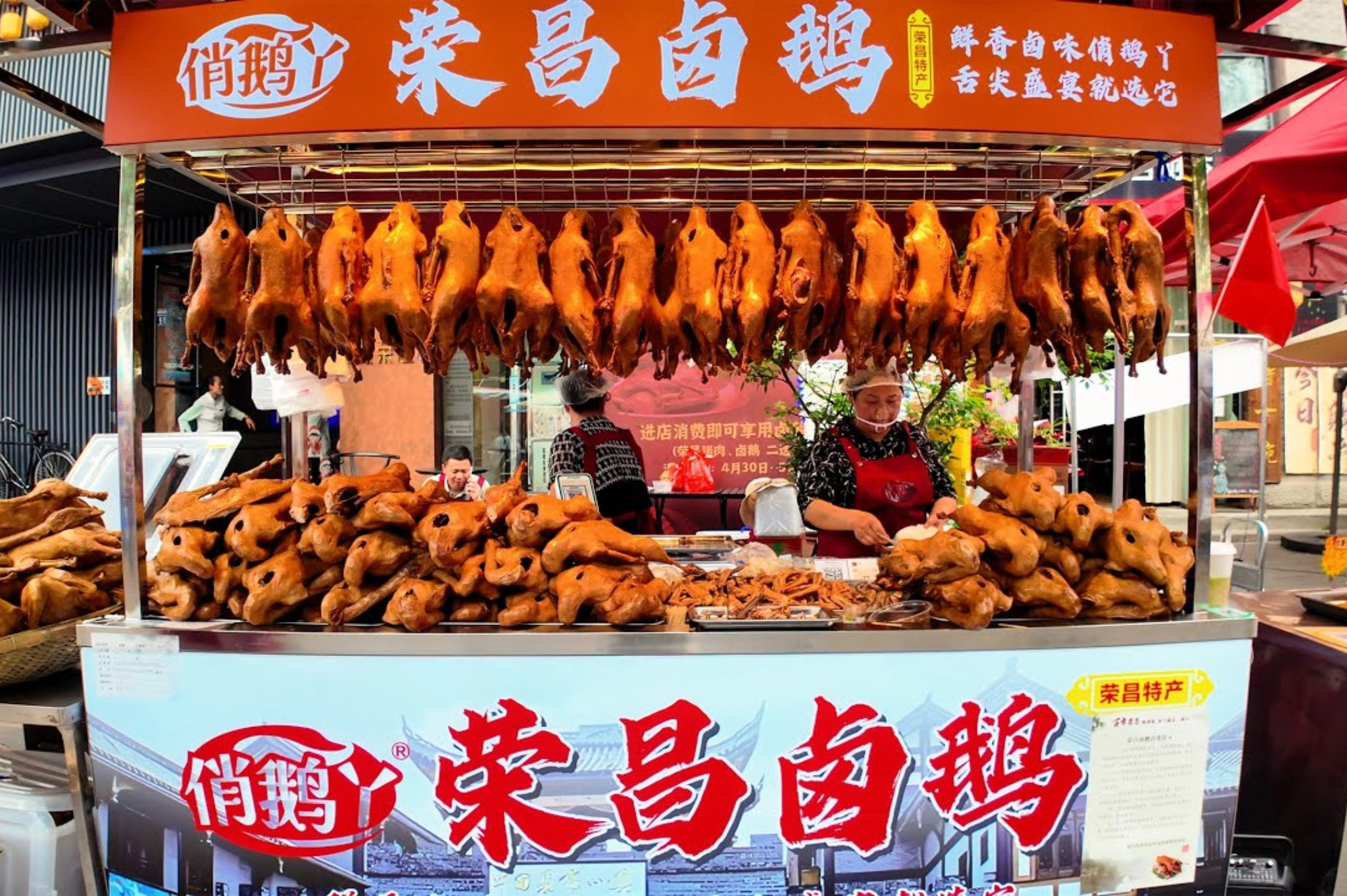
Rongchang braised goose is a Chongqing speciality, and it is not spicy.
That sentence causes more confusion than anything else about this dish, so it is worth sitting with. Chongqing's global food identity is mala — the numbing-and-burning combination of Sichuan peppercorn and chilli — and visitors arrive braced for it. Hotpot, Xiaomian, Laziji, Maoxuewang. The entire reputation is heat.
Braised goose is something else entirely. It belongs to a technique family called lu — braising in a spiced master stock — and its flavour is aromatic, savoury, faintly sweet, and deep rather than aggressive. There is no chilli in the brine.
That makes it one of the single most useful dishes in the region for travellers who cannot eat mala, are travelling with children, or have simply hit day four of a Chongqing trip and need their mouth back. Lin Jiang understood this perfectly. He didn't learn the English for "delicious."He learned the English for "not spicy."
Where It Came From: A Migration, a Goose, and Two Cuisines Colliding
The history is the reason this dish tastes the way it does, and it is a genuinely good story about how Chinese regional food actually forms.
Between roughly the 17th and 19th centuries, Sichuan and Chongqing were repopulated in one of the largest internal migrations in Chinese history which moved enormous numbers of people from Hunan, Hubei, Guangdong and Jiangxi into the regions depopulated by war and famine.
Among the arrivals were Hakka families carrying a technique from the Chaoshan region of eastern Guangdong: braising goose in a maintained spiced master stock. Chaoshan brine work is one of the great braising traditions in China — restrained, fragrant, heavily reliant on the accumulated depth of a stock that is never thrown away.
What they found waiting in Rongchang was a bird: the Rongchang White Goose, a locally bred variety raised across the district.
Chaoshan method met Chongqing ingredient, and then the Sichuan brine tradition — thicker, more heavily spiced, more assertive — pulled it partway in a third direction. What emerged over roughly three hundred years is its own thing: Chaoshan-leaning in balance, Sichuan in body.
In April 2011 the craft was formally recognised: Rongchang white goose braising technique entered Chongqing's third batch of municipal-level intangible cultural heritage.
The Hakka thread never broke. Of the 300-plus braised goose shops in Rongchang today, more than 60% are run by descendants of Hakka migrants — and the family of recognised heritage inheritor Lan Hua'an has cooked it for five generations.
How It's Actually Made
The method is not complicated to describe but extremely difficult to do well, which is the usual shape of a heritage food.
The bird: A local white goose at 70–80 days old. This is the whole first decision. Younger and there is no flavour; older and the meat coarsens and stops taking the brine. Seventy to eighty days is the window where the flesh is fine-grained enough to absorb the stock.
The preparation: The bird is cleaned and blanched in boiling water. Then comes a step with a trade name: cuo han pi — literally "rubbing the dry skin" — a second wash after blanching. It removes the raw, gamey smell and, critically, conditions the skin so that it takes colour evenly during braising. Skip it and the goose comes out patchy and faintly barnyard.
The brine: Rongchang braised goose is red brine, meaning caramelized sugar colouring goes into the stock to give the finished bird its mahogany gloss.
The aromatics: star anise, cassia bark, sand ginger, white cardamom, clove, fennel seed. The spice bag is blanched before it goes in — a detail practitioners insist on, because it takes the harsh edge off and produces a brine that is fragrant without being hot-tempered.
The braise: Thirty minutes at a hard boil to drive the spices out of the bag and into the liquid. Then thirty minutes low, so the flavour walks into the meat instead of being blasted at it. One hour, two temperatures.
The stock: This is the part that cannot be bought. A working Rongchang brine is an old master stock, topped up and never discarded, carrying the accumulated body of every bird that has passed through it. Shops in the district advertise brines thirty years deep. It is the same principle as a sourdough starter, and it is why an identical recipe executed in your kitchen will not taste like the thing in Rongchang.
Eaten: chopped on the bone, at room temperature or barely warm, often with a little of the brine spooned over. Skin glossy and taut, meat firm rather than falling apart, flavour that arrives slowly and stays.
What Happened After the Video
The interesting part of the 2025 story is not that a clip went viral. Clips go viral constantly. It is what a small district did with sixty days of global attention.
Within weeks, Rongchang's government published an Action Plan for the High-Quality Development of the Braised Goose Industry, with targets stated out loud: by 2026, cultivate 3 leading enterprises and 5 scale enterprises, push total industry output value past 1 billion yuan, build out a supply system of central kitchens, regional warehouses, community retail and e-commerce, and add 1,000+ new physical and online stores.
They also reimbursed Lin Jiang's entire cross-province travel bill and gave him a 100,000 yuan award.
Whether that converts a spike into an industry is a fair question, and Chinese commentators asked it loudly at the time — the cautionary examples of other cities that went viral and then didn't were cited constantly. But for a traveller the practical effect is simple: Rongchang is far better set up for visitors in 2026 than it was in 2024. More shops, clearer signage, a district that knows outsiders arrive specifically to eat one thing.
The Rest of Rongchang, Since You're Going Anyway
Rongchang is a real place with a history that predates the goose, and it is forty minutes from Chongqing. Three things are worth knowing:
The Three Treasures — the district's historic craft exports: Rongchang pottery, counted among China's four great pottery traditions; Rongchang folding fans; and Rongchang summer cloth, a fine ramie textile. The pottery in particular has a living workshop scene and is the best souvenir in western Chongqing.
The Rongchang pig — one of China's most important indigenous pig breeds, and a genuinely significant piece of agricultural heritage. The district is a national livestock research centre.
Position: Rongchang sits on the Chengdu–Chongqing corridor, which makes it one of the easiest possible stops to insert between the two cities rather than a detour from either.
Why This Dish Matters More Than It Looks
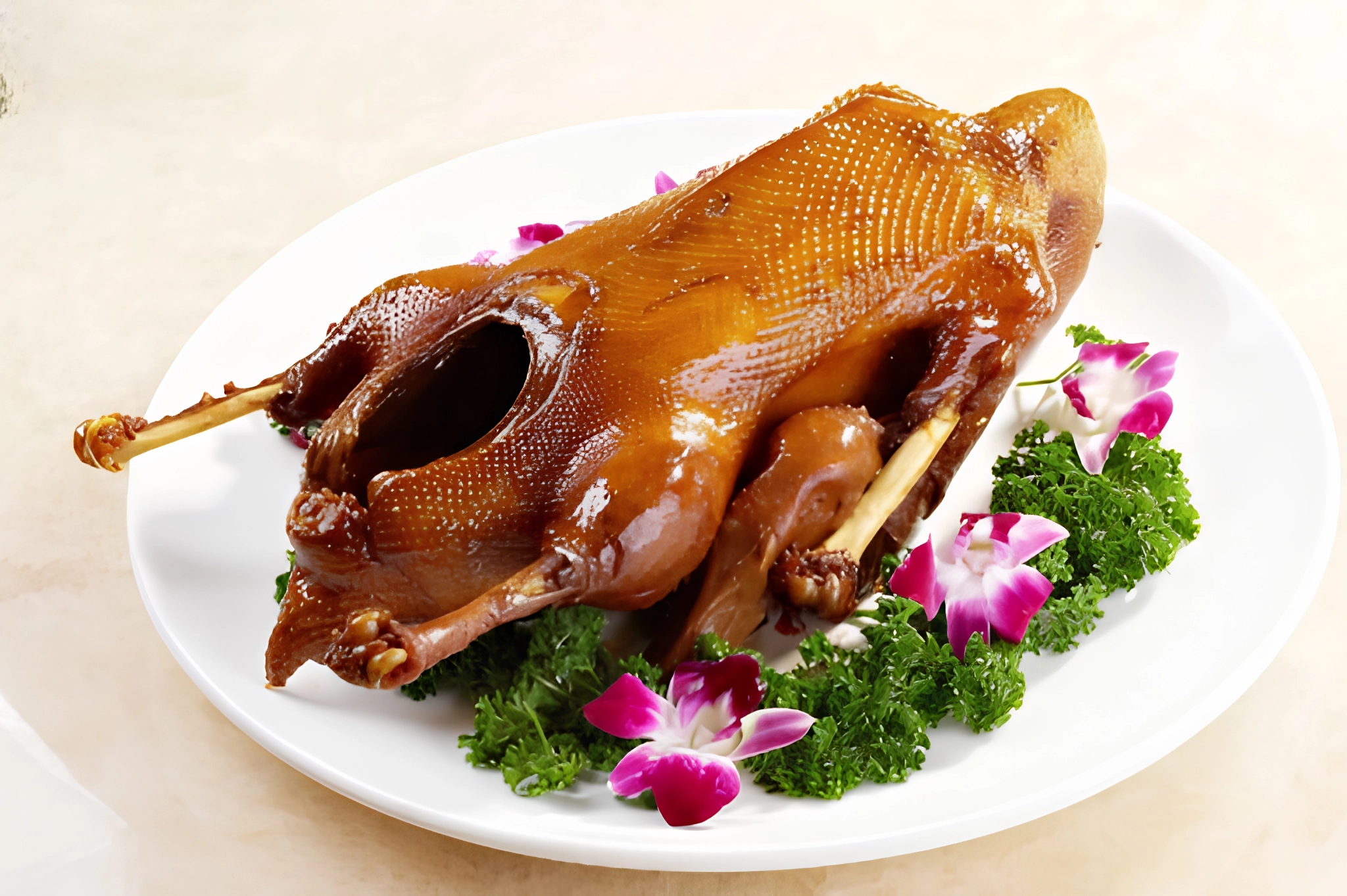
It fixes the spice problem. Every group that comes to Chongqing contains at least one person who cannot do mala, and by day three that person is unhappy. Braised goose, sour radish and duck soup, and open-water cabbage are the three dishes that solve it — and braised goose is the one that is also a headline attraction.
It is an unusually clean example of how Chinese food goes global now. Not through restaurants abroad, not through diaspora, not through a cookbook — through a man with a phone, an AI translation app, and an eight-day pursuit of a streamer he could not otherwise speak to. Whatever you think of that as a cultural phenomenon, it is the actual mechanism, and Rongchang is the clearest case study anyone has.
Practical Guide for Foreign Visitors, 2026
Dish: Rongchang braised goose (Róngchāng lǔ'é).
What it is: Whole white goose braised in a spiced red master stock; served chopped, cool or barely warm.
Spice level: None. No chilli in the brine. Safe for children and for anyone mala-fatigued.
Where: Rongchang District, western Chongqing — on the Chengdu–Chongqing line.
Getting there: Bullet train to Rongchang North Station — roughly 30–50 minutes from Chongqing, around an hour or less from Chengdu. Frequent services; book on the 12306 app or through a hotel.
Heritage status: Municipal-level intangible cultural heritage of Chongqing since April 2011.
Age of tradition: Around 300 years; 30+ goose shops recorded in the county town by the Daoguang reign (1821–1850).
How many shops: 300+ in the district; over 60% run by Hakka-descended families.
What to order: A half or quarter goose if you are not a group — a whole bird is a lot. Ask for brine on the side.
Price: A whole goose typically runs in the low-to-mid hundreds of yuan; a portion is far less.
Best combined with: Rongchang pottery workshops; a Chengdu–Chongqing rail stopover; or simply as a day trip out of either city.