
Every spring, hundreds of thousands of people walk behind a carved wooden palanquin across central Taiwan for nine days and eight nights. Firecrackers explode at every crossroads. Strangers hand out free water, rice and massages. Pilgrims kneel in the road so the goddess can pass over them.
The goddess is Mazu, protector of sailors and fishermen. Her story begins on a small island off the coast of Fujian, in mainland China, more than a thousand years ago. Today her largest celebrations take place in Taiwan, and they draw believers and travelers from across Asia and beyond. This is the story of how she crossed the sea, and how you can witness her pilgrimage yourself.
Mazu: How a Fujian Sea Goddess Became Taiwan's Greatest Pilgrimage
Fujian · Taiwan
Mazu Pilgrimage Taiwan
From Fujian to the Dajia Procession
Key PointsThe Story in Six Lines
Short on time? Here is the story of Mazu and her pilgrimage in brief.
- 1Born on Meizhou IslandTradition says Mazu was Lin Moniang, born in 960 AD near Putian in Fujian. She is the protector of sailors and fishermen.
- 2Named Empress of HeavenEmperors granted her rising titles, and in 1684 the Kangxi Emperor named her Tianhou.
- 3The faith crossed the StraitBetween the 17th and 19th centuries, Fujian settlers carried Mazu statues and incense ash to Taiwan and built temples to thank her.
- 4Dajia: 9 days, about 340 kmThe pilgrimage leaves Dajia Jenn Lann Temple for Fengtian Temple in Xingang and returns, crossing four regions of central Taiwan.
- 5The goddess sets the dateDivination blocks are cast on the Lantern Festival, so the start date is only announced about two months ahead.
- 6Anyone can joinYou do not need to be a believer. Most participants walk only a section of the route.
Who Is Mazu?
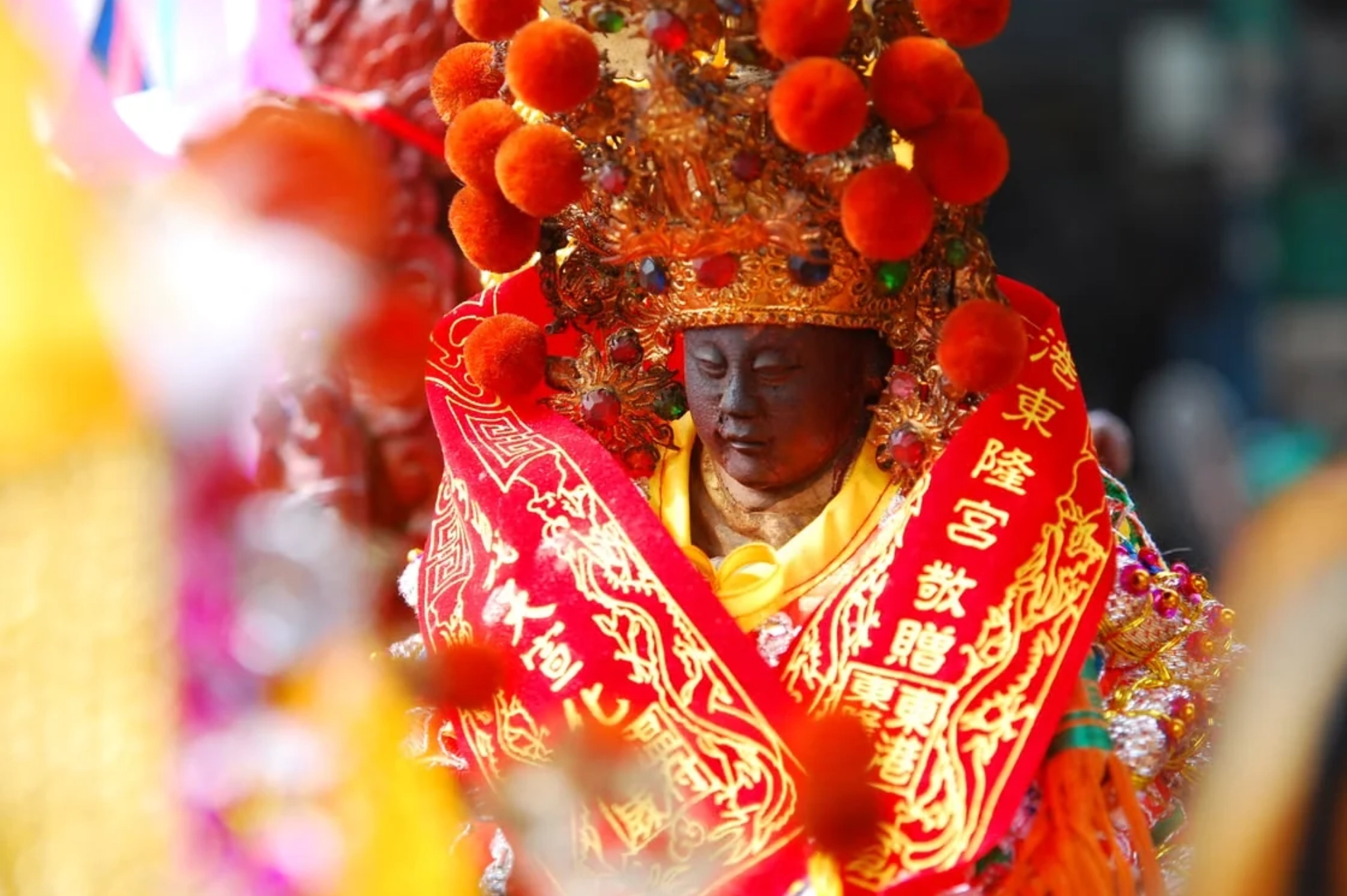
According to tradition, Mazu was born as Lin Moniang in 960 AD on Meizhou Island, near Putian in Fujian province. Legends say she did not cry as a baby, earning the name Moniang, "silent girl." As she grew up she was said to predict the weather and to rescue fishermen in storms, sometimes by appearing to them in dreams or visions.
She died young, traditionally at the age of 28 in 987 AD. Coastal communities began worshipping her soon after. Over the centuries, Chinese emperors granted her rising titles, and in 1684 the Kangxi Emperor named her Tianhou, the Empress of Heaven.
In temples, Mazu is usually shown seated, wearing an imperial crown with beaded strings. She is often flanked by two guardian generals: Qianliyan ("Thousand-Mile Eyes") and Shunfeng'er ("Wind-Following Ears"), who see and hear sailors in danger.
From Fujian to Taiwan: A Faith That Crossed the Sea
Between the 17th and 19th centuries, large numbers of settlers from Fujian crossed the Taiwan Strait. The crossing was dangerous, and many travelers carried a small statue of Mazu or a pouch of incense ash from their home temple for protection.
When they arrived safely, they built temples to thank her. New temples often received a statue or incense from an older "mother temple," a practice called fenxiang, or "dividing the incense." This created a network of related temples that still visit one another today.
Some of Taiwan's best-known Mazu temples include:
- Tianhou Temple, Magong (Penghu): widely considered one of the oldest Mazu temples in Taiwan.
- Lukang Tianhou Temple (Changhua): known for a statue said to have come from Meizhou.
- Beigang Chaotian Temple (Yunlin): one of the most visited temples on the island.
- Dajia Jenn Lann Temple (Taichung): starting point of the Dajia Mazu Pilgrimage.
Today there are hundreds of Mazu temples across Taiwan. Some counts exceed one thousand.
Meizhou Island Today
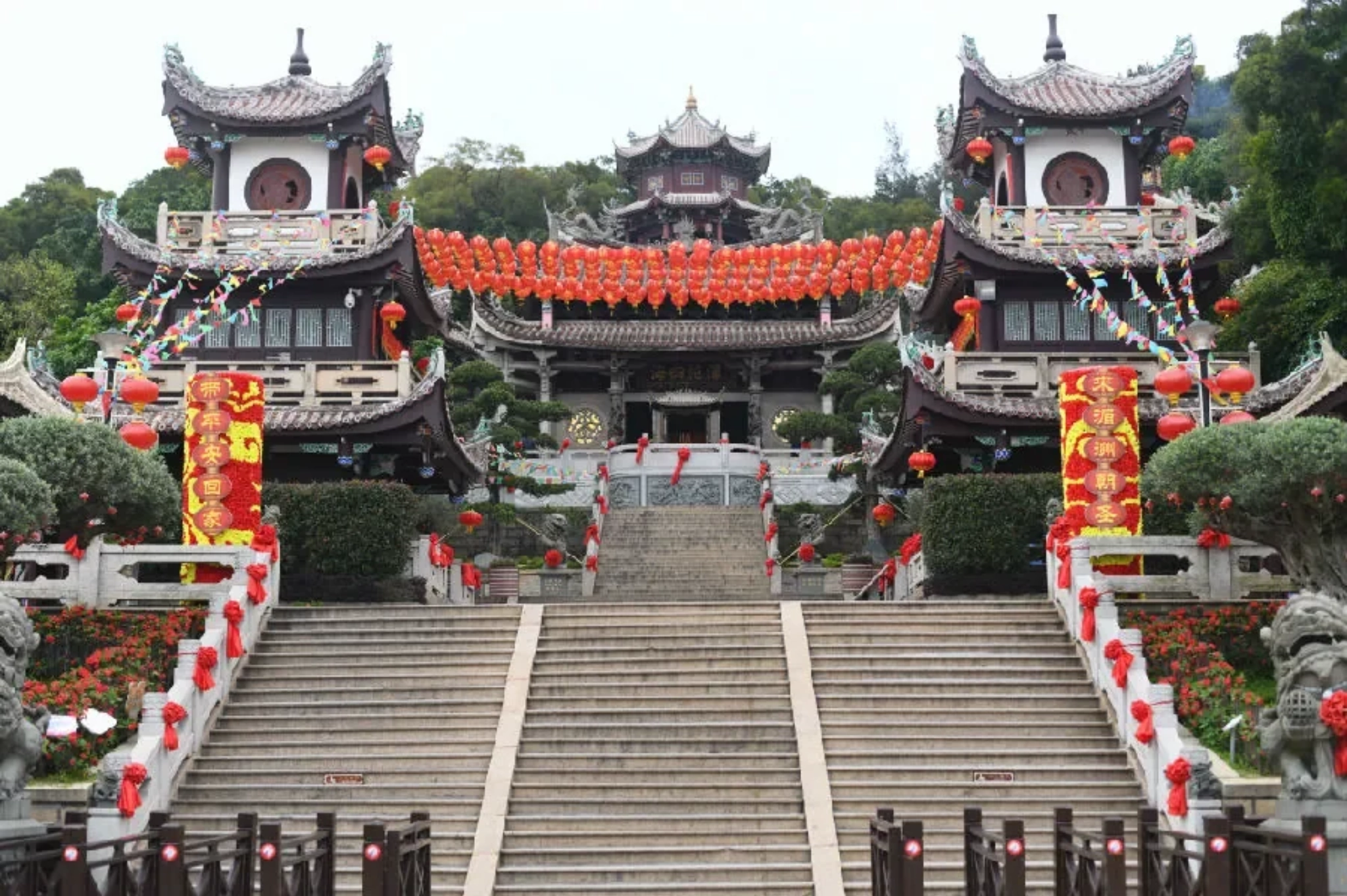
Meizhou Island remains the spiritual home of Mazu. The Meizhou Mazu Ancestral Temple climbs a hillside above the sea, crowned by a giant granite statue of the goddess facing the water. On Mazu's birthday, the 23rd day of the third lunar month, the island hosts formal ceremonies with music, dance and offerings.
In 2009, UNESCO inscribed "Mazu belief and customs" on its list of the Intangible Cultural Heritage of Humanity. The listing recognizes a tradition shared by an estimated hundreds of millions of people across coastal China, Taiwan and the Chinese diaspora.
The Dajia Mazu PilgrimageThe Route at a Glance
AStart and finishDajia Jenn Lann Temple, Taichung
⇄
DestinationFengtian Temple, Xingang, Chiayi CountyB
Taichung
Changhua
Yunlin
Chiayi
Duration9days 8nights9 days, 8 nights
Distance340kmAbout 340 km round trip
TimingSpringSpring, around the third lunar month
Date set byDivinationDivination blocks cast at the temple on the Lantern Festival
What Happens Along the Route
- The palanquin: Mazu's statue travels in a sedan chair carried by teams of bearers, day and night.
- Crawling under the palanquin: Believers kneel in a long line on the road so the palanquin passes over them, a gesture of blessing.
- Free food and rest stations: Families and businesses along the route set up tables of free food, drinks and places to rest. This generosity is one of the most moving parts of the event.
- Firecrackers and drums: Temple troupes, lion dancers and performers in giant deity costumes join the procession.
The exact date is not fixed in advance. Each year on the Lantern Festival, the 15th day of the first lunar month, temple leaders cast crescent-shaped divination blocks to ask Mazu when she wishes to set out. The date is usually announced that evening.
The Baishatun Pilgrimage: Where the Goddess Chooses the Road
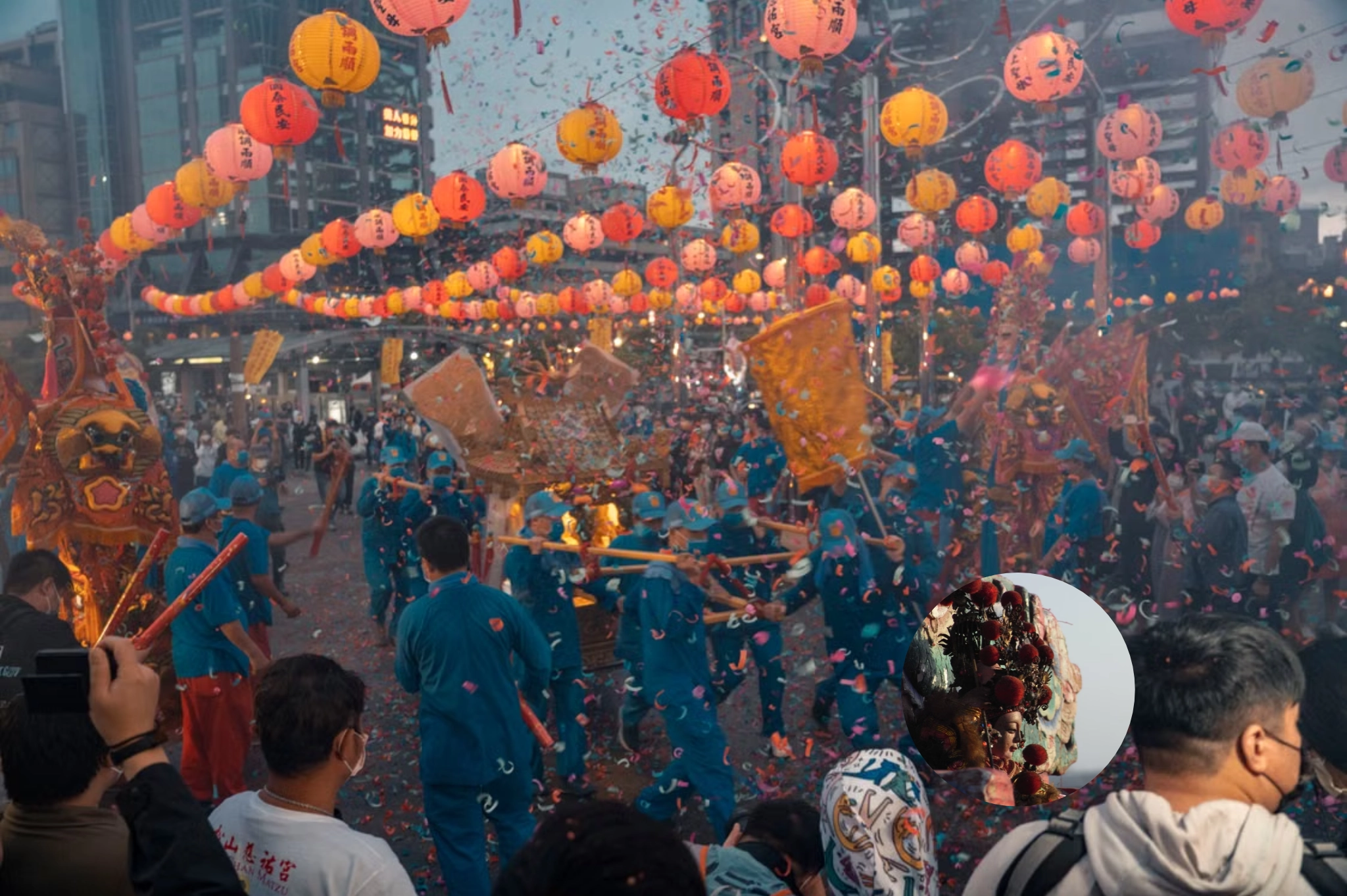
The second great pilgrimage starts at Gongtian Temple in Baishatun, Miaoli County, and travels to Beigang Chaotian Temple. It covers around 400 km. Unlike Dajia, its route is not planned in advance. Believers say Mazu herself guides the palanquin, which can suddenly turn into a side street, a private home or a field. Her pink palanquin, moving fast, has earned the affectionate nickname "the pink supercar."
Same Goddess, Two ShoresMeizhou vs. Taiwan
The RootMainland China (Meizhou)
The CelebrationTaiwan
01Role
MeizhouPlace of origin and ancestral temple
TaiwanLargest living pilgrimage culture
02Main events
MeizhouBirthday ceremonies, formal rites
TaiwanMulti-day walking pilgrimages
03Style
MeizhouCeremonial and organized
TaiwanFolk-driven, loud, deeply participatory
04Community
MeizhouCoastal Fujian, pilgrims from across Asia
TaiwanTemple networks across the island
05Connection
MeizhouTaiwanese temple groups visit Meizhou to "return to the ancestral temple"
TaiwanPilgrims see the trip as linking their temple to its roots
Mazu Around the World
Mazu followed Chinese migrants across the world. Temples dedicated to her can be found in Malaysia, Singapore, Indonesia, the Philippines, Vietnam and Japan, as well as in North America. Many believers from these communities travel to Taiwan each spring to walk part of the pilgrimage.
How Visitors Can Join
You do not need to be a believer to take part. Most participants walk only a section of the route.
- Pick a section. Walking one day, or even one evening, is common and welcome.
- Follow the volunteers. Temple staff in uniforms manage the crowd. Never block the palanquin's path.
- Do not touch the palanquin unless invited.
- Bring earplugs. Firecrackers are constant and very loud.
- Wear good walking shoes and carry water, sunscreen and a rain jacket.
- Accept offered food politely. It is given as a blessing.
- Photograph respectfully. Avoid flash during rituals and ask before photographing individuals in prayer.
- Book accommodation early. Towns along the route fill up quickly.
Plan Your Trip
The pilgrimage date is only announced at the Lantern Festival, about two months before it starts. If you want to experience it, plan a flexible spring trip to central Taiwan and lock in dates as soon as the announcement is made. Pair it with a visit to Meizhou Island in Fujian, and you will have followed Mazu's journey from its source to its biggest celebration.
FAQ
Frequently Asked Questions
01Who is Mazu?
Mazu is a Chinese sea goddess, traditionally said to be Lin Moniang, born in 960 AD on Meizhou Island in Fujian. She protects sailors and fishermen and is widely worshipped in Taiwan.
02When is the Dajia Mazu Pilgrimage?
It takes place in spring, around the third lunar month. The exact date is chosen by casting divination blocks at Dajia Jenn Lann Temple on the Lantern Festival.
03How long is the Dajia Mazu Pilgrimage?
It lasts 9 days and 8 nights and covers about 340 km across Taichung, Changhua, Yunlin and Chiayi.
04Can foreigners join the Mazu pilgrimage?
Yes. Visitors can walk any section of the route. Follow the volunteers, do not touch the palanquin, and bring earplugs for the firecrackers.
05Is Mazu worship recognized by UNESCO?
Yes. "Mazu belief and customs" was inscribed on UNESCO's Intangible Cultural Heritage list in 2009.