The 1,300-Year-Old Mosque Hidden Behind Xi'an's Busiest Food Street —
It Has No Dome, No Minaret, and Looks Exactly Like a Chinese Temple
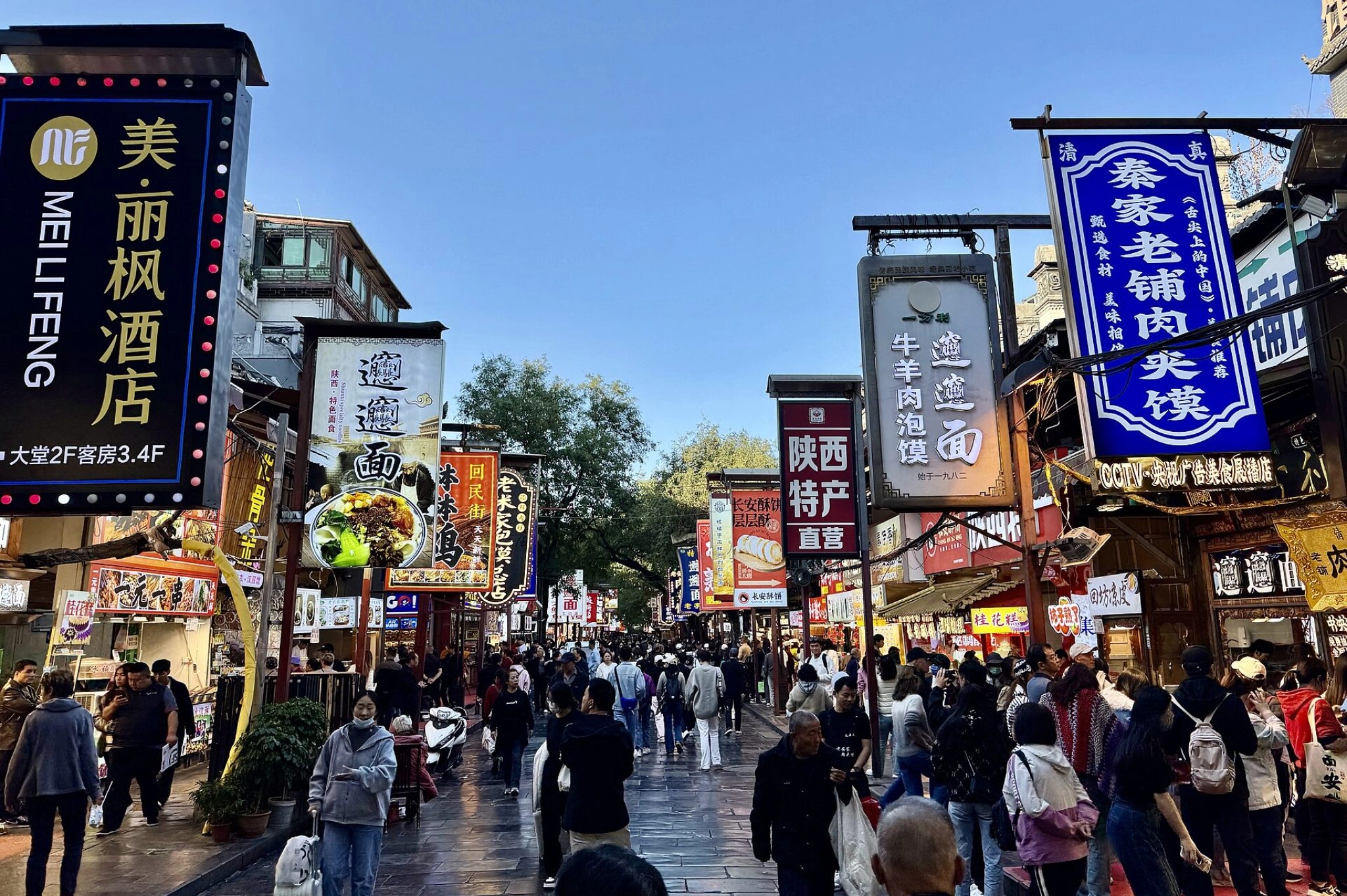
Every visitor to Xi'an ends up on Beiyuanmen, the lantern-lit lane behind the Drum Tower where the pomegranate juice is pressed in front of you, the lamb is turning on skewers, and roughly four thousand people per hour are photographing a man pounding persimmon cakes.
Almost nobody turns left.
About halfway up, an unremarkable alley called Huajue Lane branches off, lined with stalls selling jade, scrolls and terracotta-warrior fridge magnets. Follow it for two minutes and the noise drops away. At number 30 there is a gate.
Behind that gate is a 12,000-square-metre walled compound of courtyards, ancient cypresses, stone archways, carved timber gateways and a three-storey octagonal pagoda — and if you were dropped into it blindfolded, you would say with total confidence that you were standing in a Confucian temple or a Ming-dynasty garden.
Instead, you would be standing in one of the oldest and largest mosques in China, which has held Friday prayers continuously for centuries and still does today.
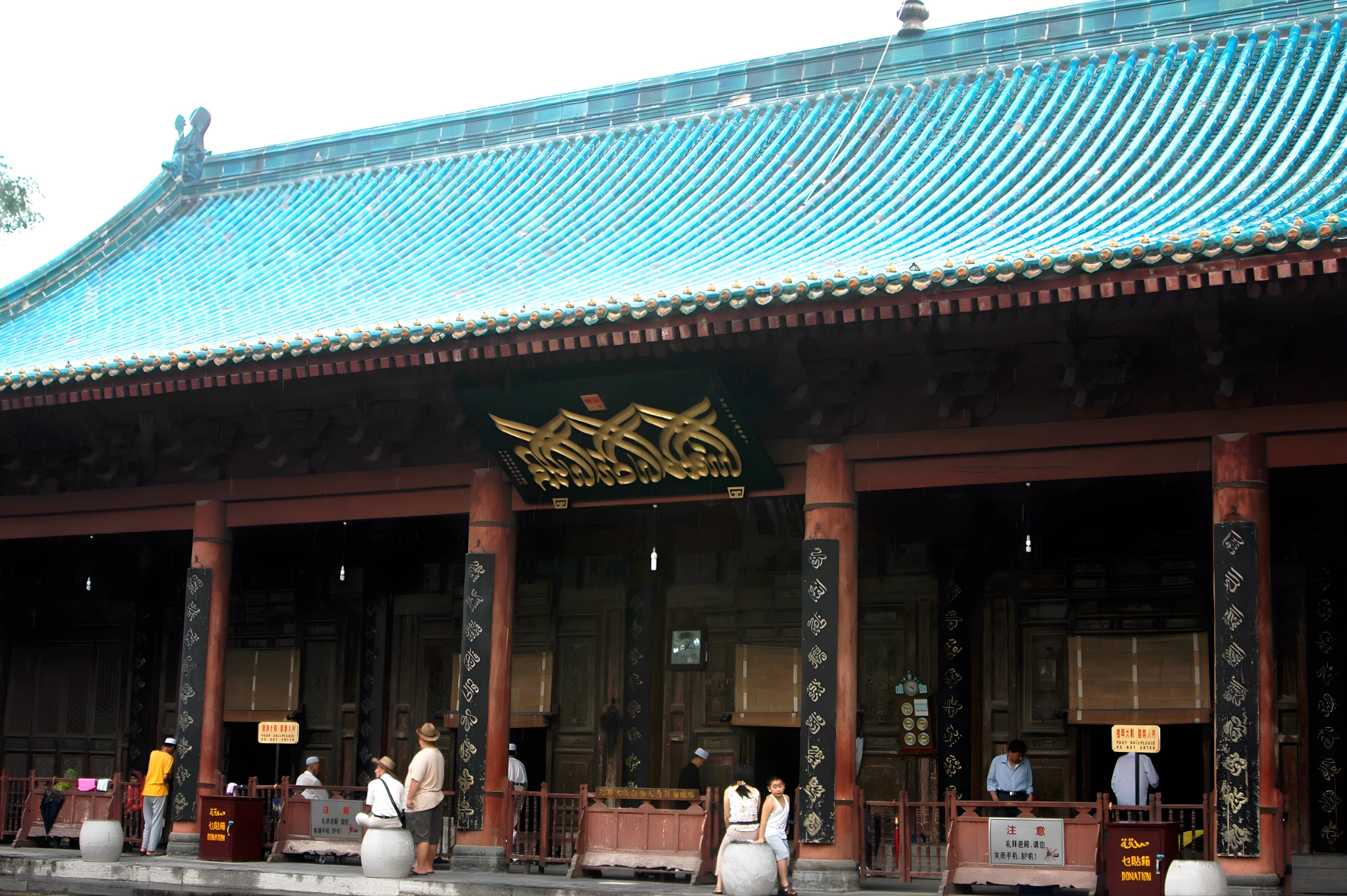
There is no dome. There is no minaret in any shape you would recognise. There are no arches, no horseshoe windows, no geometric tilework façade. There are flying eaves, upturned roof corners, painted beams, glazed grey tiles, stone tortoises carrying steles, and a pavilion arranged to look like a phoenix spreading its wings.
This is what happens when a religion arrives along the Silk Road and spends thirteen centuries becoming Chinese. It is the single most intellectually interesting building in Xi'an, and the overwhelming majority of foreign visitors walk past the end of its alley eating a lamb skewer.
The Basics
The Great Mosque of Xi'an (西安清真大寺, Xī'ān Qīngzhēn Dàsì) | |
| Also called | Huajue Lane Mosque (化觉巷清真大寺) · the Great Eastern Mosque |
| Address | 30 Huajue Lane, off Beiyuanmen, immediately northwest of the Drum Tower |
| Traditional founding | 742 CE — Tianbao era, reign of Emperor Xuanzong of Tang |
| Present complex | Largely Ming dynasty onward; major reconstruction under the Hongwu Emperor, 1392, with Qing-era repairs |
| Layout | Four successive courtyards on a single east–west axis, roughly 250 m long, about 12,000 m² total |
| Architectural style | Chinese palace-and-garden architecture, Islamic in function and content only |
| The "minaret" | Xingxin Lou (省心楼), the "Tower of Introspection" — a three-storey octagonal Chinese pagoda used for the call to prayer |
| The famous pavilion | Yizhen Ting (一真亭), the "Pavilion of Oneness" — a hexagonal centre flanked by two triangular pavilions, together resembling a bird in flight; hence Phoenix Pavilion (凤凰亭) |
| The rare stele | The Moon Tablet (月碑), erected 1732 (Yongzheng reign), in Arabic, explaining the calculation of the Islamic lunar calendar |
| Orientation | The complex runs east to west — because Mecca lies west of China. |
| Status | National Key Cultural Relic Protection Unit; an active place of worship, not a museum |
| Community | The Hui (回族) — Chinese-speaking Muslims, the community that also runs the food street outside |
| Tickets (2026) | Approx. ¥15 low season / ¥25 high season |
| Time needed | 45–90 minutes |
How Islam Got to Xi'an Before It Got to Most of Europe
Start with the date, because it is the part that resets people's assumptions.
The traditional founding year is 742 CE. For scale: the Prophet Muhammad died in 632. Charlemagne was not yet born. The Umayyad Caliphate was still standing. And already, in the Tang capital of Chang'an — then the largest and most cosmopolitan city on earth, with a population approaching a million and a foreign quarter full of Sogdians, Persians, Arabs, Turks and Indians — there was a mosque.
This is the Silk Road in its literal sense. Chang'an was the eastern terminus. Arab and Persian merchants came the whole way, and a proportion of them stayed, married locally, and had children who spoke Chinese. Those descendants, across more than a thousand years, became the Hui — one of China's 56 officially recognised ethnic groups, Chinese in language, dress, surname and cuisine, Muslim in faith.
Historians treat the 742 date as traditional rather than documented, and almost nothing of any Tang structure survives; the Tang fell, the Song fell, and the mosque was rebuilt at least four times. Most of what stands today dates from the Ming reconstruction of 1392 onward, under the founding emperor of the dynasty.
But the essential point holds regardless of which century you date the stones to: there has been a Muslim community praying on this site for roughly the entire history of Islam in China, and their mosque has been rebuilt, repeatedly, in the architectural language of the country they lived in.
Reading the Building: Four Courtyards, One Argument
The mosque is laid out as a sequence of four courtyards, each entered through a gate, each quieter and more private than the last. This is not an Islamic plan. It is the plan of a Chinese temple or an official's residence — an axial progression from public to sacred, exactly as you would find at a Confucian temple or in the Forbidden City.
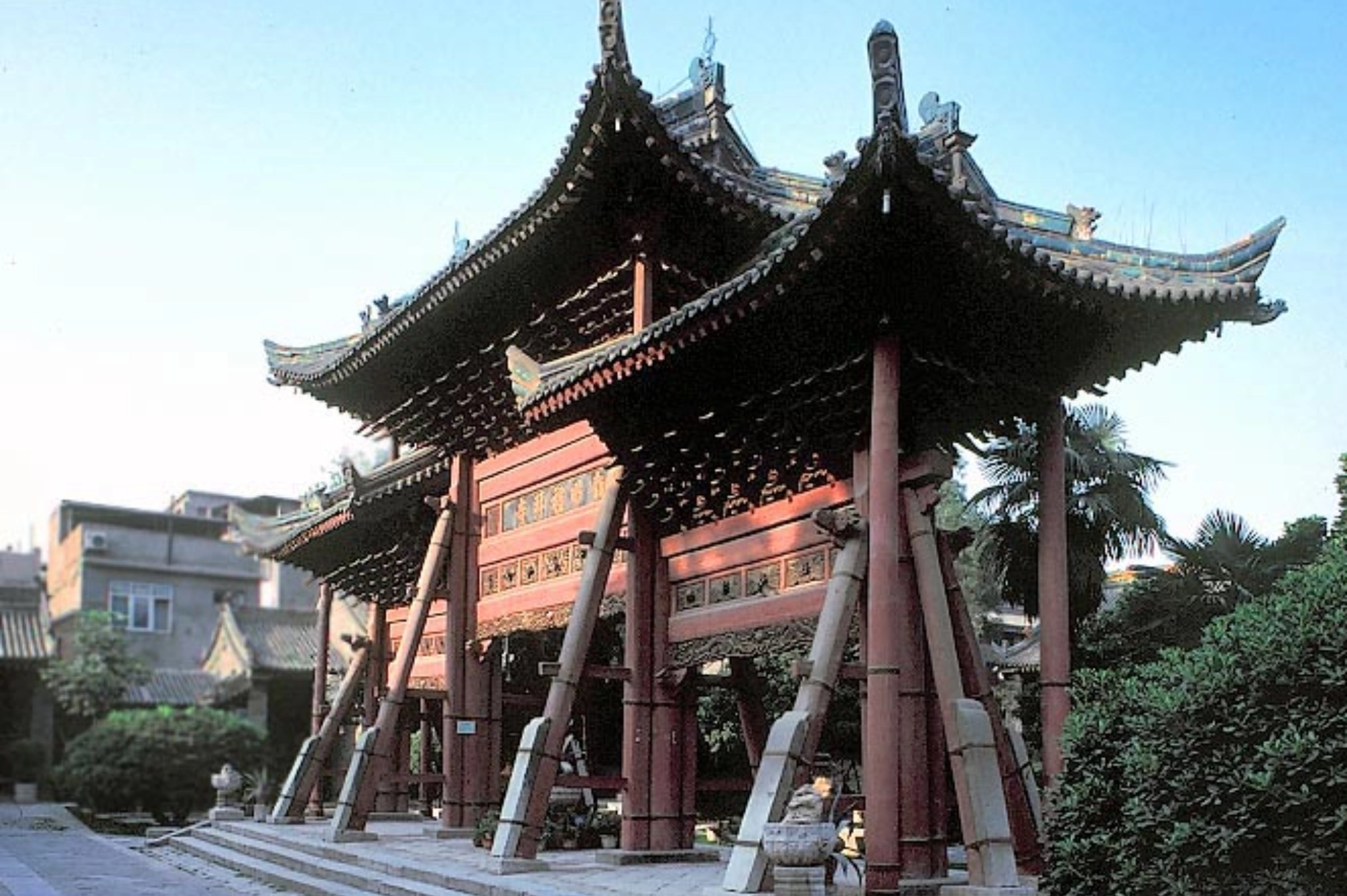
First courtyard. A wooden pailou — a free-standing timber gateway with glazed tiles and upturned eaves, about nine metres high. Any visitor to China has seen a hundred of these. None of the others were mosque gates.
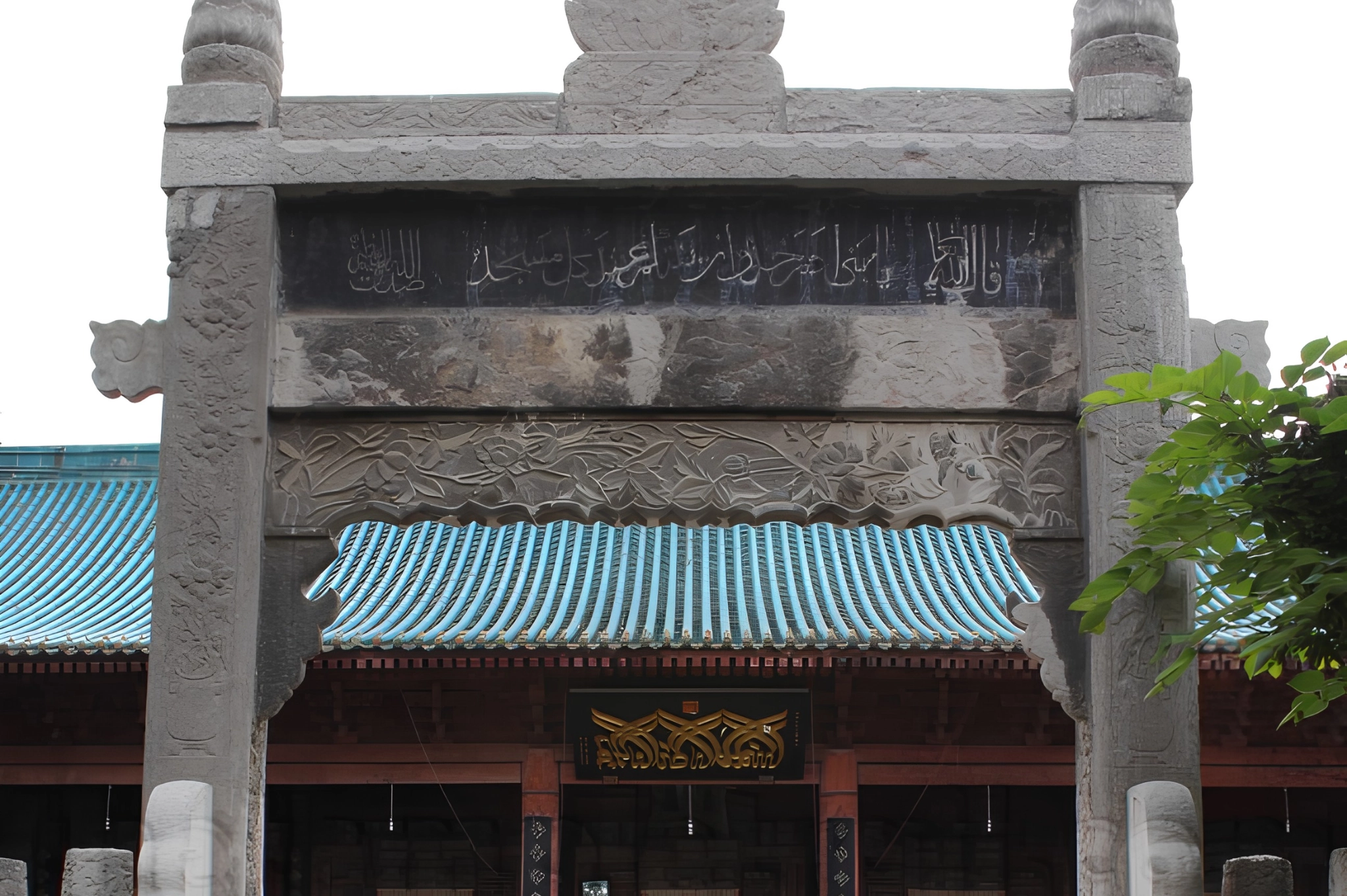
Second courtyard. A stone archway and stone steles. This is where the mosque's most-repeated claim lives: two tablets traditionally attributed to the great calligraphers Mi Fu (Song dynasty) and Dong Qichang (Ming). Treat the attributions as tradition rather than settled scholarship — but the fact that a mosque displays Chinese literati calligraphy as its treasure is the real story here, and that part is not in doubt.
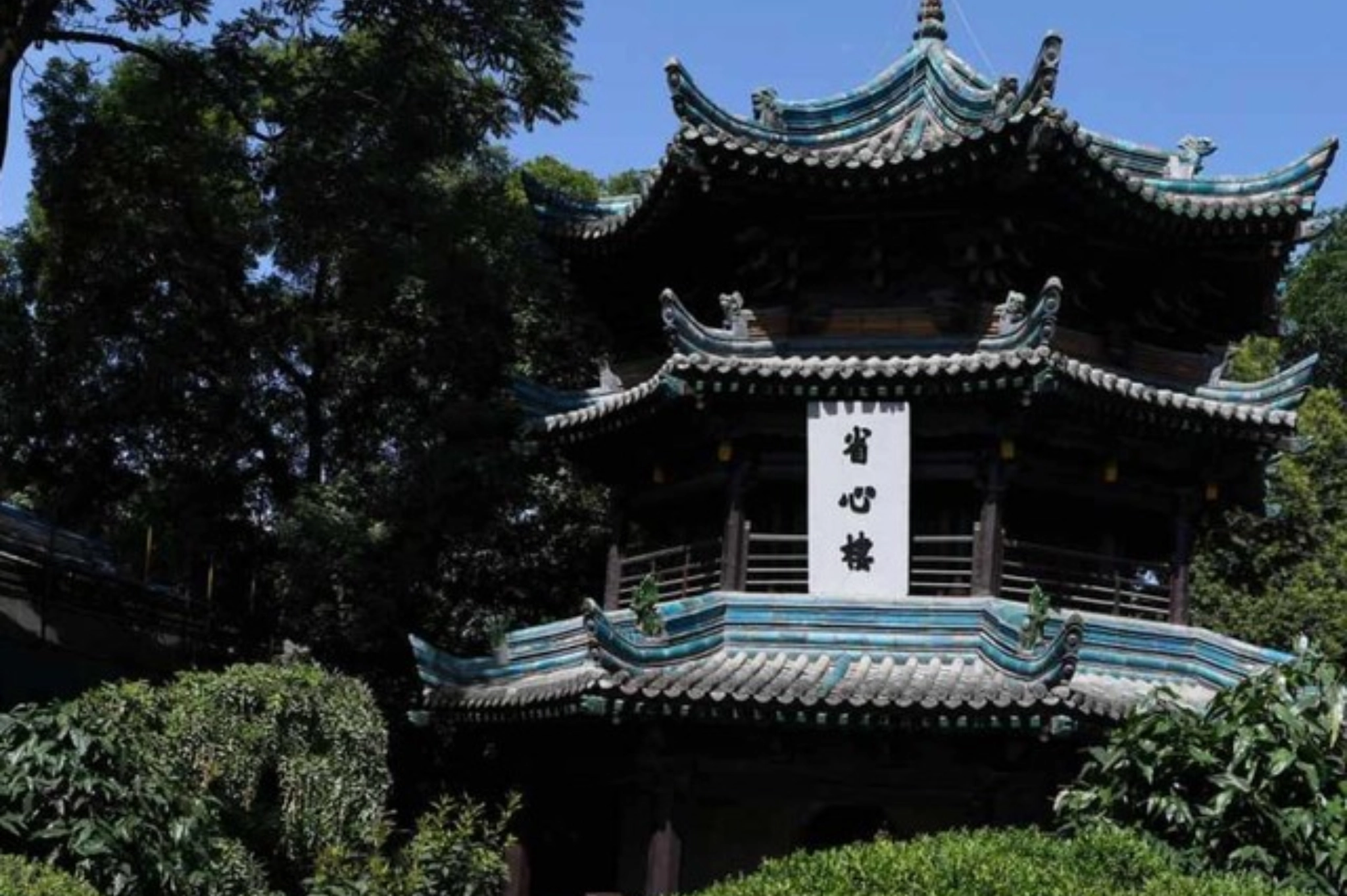
Third courtyard. The centrepiece: Xingxin Lou, the "Tower of Introspection."Functionally this is the minaret — the tower from which the community is called to prayer. Formally it is a three-storey octagonal Chinese pagoda, the same silhouette as a Buddhist pagoda, which is itself an Indian form that became Chinese centuries earlier. A building type that travelled from India to China, was naturalised, and was then borrowed by a religion that arrived from Arabia. Xi'an is where you can see that happen in a single object.
Also here: the Moon Tablet of 1732, inscribed in Arabic, setting out how to calculate the Islamic lunar calendar. A Chinese stone stele — the standard Chinese medium for recording law, genealogy and doctrine — carrying Arabic astronomy. The two civilisations are not side by side; they are fused into one object.
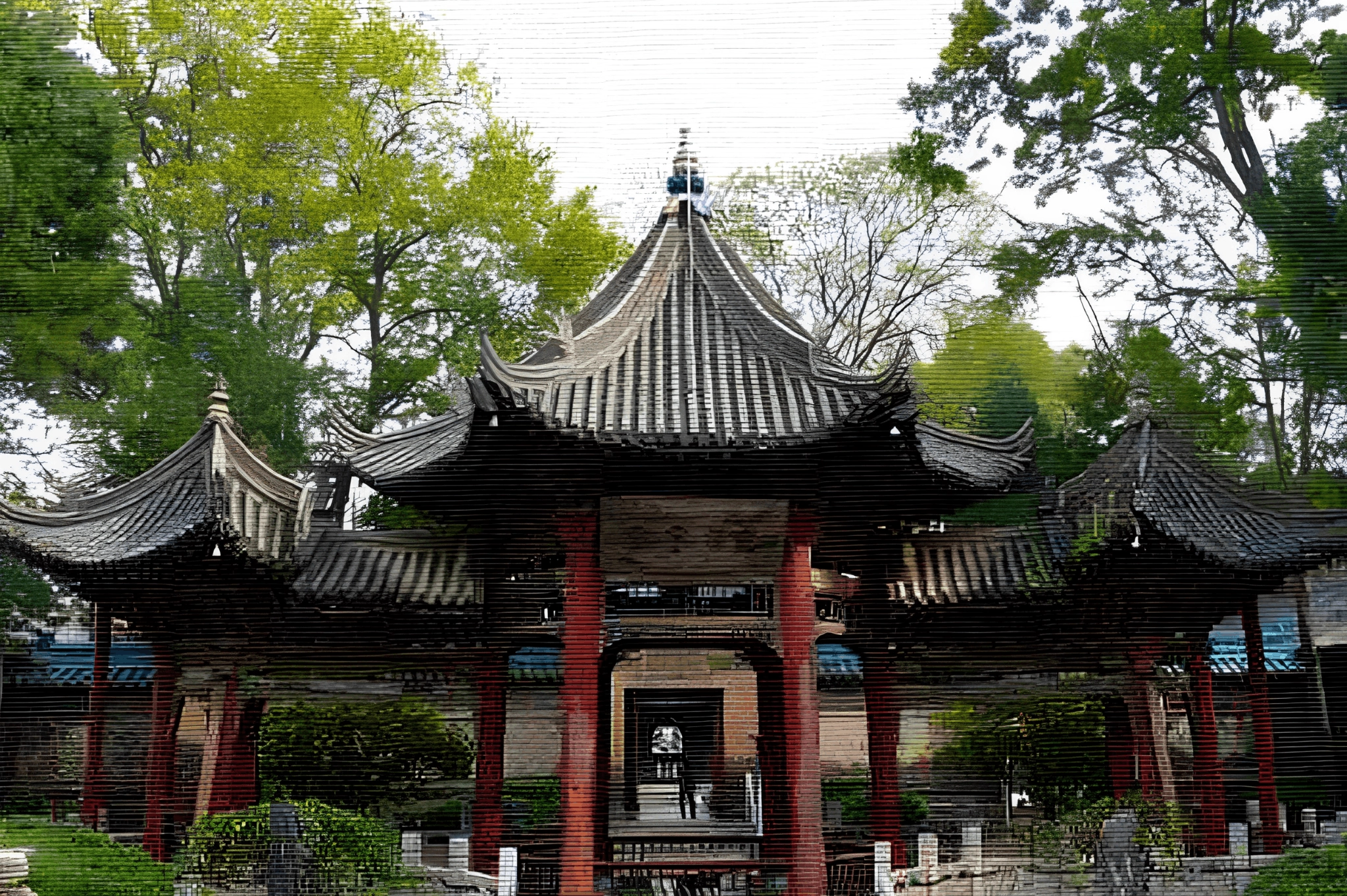
Fourth courtyard. The Yizhen Ting, "Pavilion of Oneness" — a hexagonal central pavilion with a triangular pavilion attached on either side, so the three read as a bird with outstretched wings. Locals call it the Phoenix Pavilion. The name refers to tawhid, the oneness of God, the central doctrine of Islam. The form refers to a mythological Chinese bird.
Beyond it: the moon-viewing terrace, where the community observes the new moon to fix the start of Ramadan, and then the Prayer Hall.
The Prayer Hall, and the Detail That Explains Everything
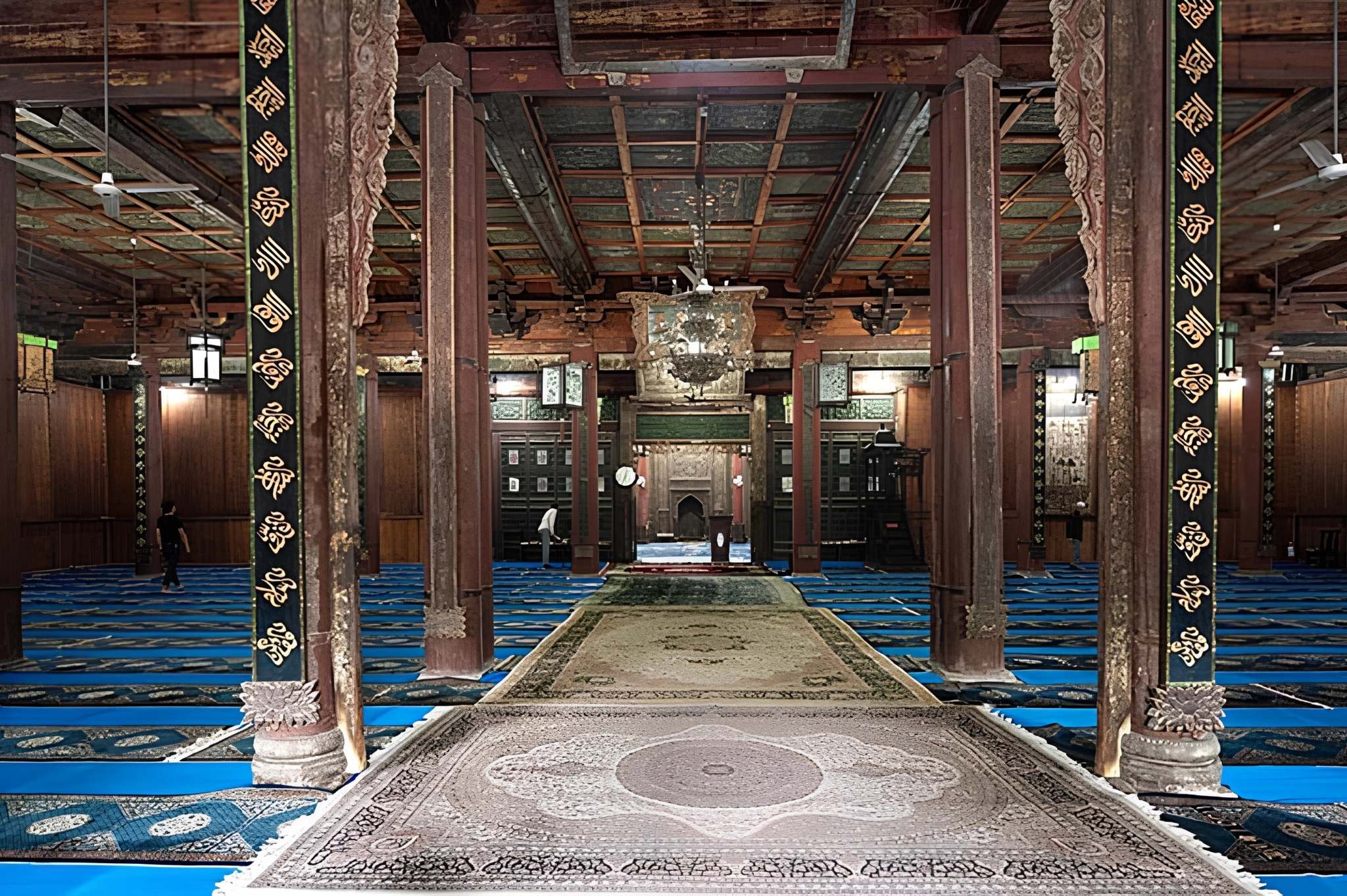
The Prayer Hall is a large timber-framed hall under a sweeping tiled roof with upturned corners. From the outside it is a Chinese hall. Inside, the ceiling is coffered and painted, and every surface that would carry a figurative image in a Buddhist or Daoist temple carries instead Arabic calligraphy and abstract plant and geometric ornament — because Islam does not depict living beings in sacred space.
That is the whole synthesis in one room. Chinese structure. Islamic content.The carpenters were local and used the only vocabulary they had; the community told them what could and could not be shown.
Then there is the orientation, which is the detail worth carrying home.
Every mosque on earth faces Mecca. In Cairo it faces roughly east; in Istanbul, south-southeast; in Jakarta, west-northwest. In Xi'an, Mecca lies west.
Chinese sacred architecture, meanwhile, is almost universally organised on a north–south axis, with the main hall facing south. Temples, palaces, tombs, ancestral halls — north-south, without exception, for thousands of years.
The Great Mosque could not do that. So the entire 250-metre complex is laid out east to west, so that worshippers in the hall at the western end face Mecca.
It is a Chinese building rotated ninety degrees by theology.Once you notice it, the whole compound reads differently: every courtyard, gate and pavilion you walked through was arranged by a compass bearing pointing at a city 6,000 kilometres away.
That is not decoration. That is a civilisation making a structural concession to a faith, and a faith accepting an architectural language in return.
Why Foreign Visitors Should Care More Than They Do
Xi'an's tourism story is overwhelmingly about two things: the Terracotta Warriors and the Tang dynasty — the pagodas, the hanfu rentals, the night shows, the Grand Tang Everbright City light displays. All of it is excellent and all of it is rightly famous.
But the deepest thing Xi'an actually has is not an army or a dynasty. It is the fact that it was, for several centuries, the place where the world met. The eastern end of the Silk Road. The city where a Persian merchant, a Sogdian musician, a Japanese envoy and a Nestorian Christian priest could all be found in the same market.
The Terracotta Warriors tell you what China was like before that happened. The Great Mosque tells you what the meeting produced — and unlike the warriors, it is not an excavated artefact. It is still in use. People still pray there five times a day. The community that built it still runs the street outside, and the lamb skewers you ate on Beiyuanmen are halal for the same reason this building is here.
The food street and the mosque share the same story. Most visitors experience only the part with the food.
Practical 2026 Guide for Foreign Visitors
Finding it. From the Drum Tower, walk into Beiyuanmen food street, then turn into Huajue Lane — a narrower souvenir alley on the left. Number 30. It is genuinely easy to miss; the stalls are dense and the mosque gate is modest. If lost, ask for "Qīngzhēn Dàsì" rather than "mosque."
Tickets and hours. Around ¥15 in low season and ¥25 in high season (2026). Daytime hours, generally from mid-morning; check on the day, because opening is subject to prayer times. Carry your passport — ID checks at ticketed sites are standard in China now.
The crucial etiquette point. This is a working mosque, not a monument. Non-Muslim visitors may walk the four courtyards and view the exterior of the Prayer Hall, but the Prayer Hall interior is generally closed to non-Muslims, particularly during prayers. Do not push, do not photograph inside, and do not treat closure as an obstacle to be negotiated. The courtyards are the majority of the experience and they are entirely open to you.
Dress. Cover shoulders and knees. Women do not need to cover their hair in the courtyards but should dress modestly. Avoid visiting during Friday midday prayers unless you are attending.
Best time of day. Early morning, before roughly 10:00. The Muslim Quarter is still asleep, the courtyards are empty, the cypresses throw long shadows, and you will have the Phoenix Pavilion to yourself. By afternoon the alley outside is shoulder-to-shoulder.
Ramadan. Dates shift annually on the lunar calendar. During Ramadan the mosque is busier, the atmosphere is more devotional, and the food street outside changes character in the evening — interesting to see, but be doubly conscious of being a visitor.
Combine it with. The Drum Tower and Bell Tower (two minutes away), Beiyuanmen food street, and the City Wall's Anding Gate. A clean half-day: mosque early → Drum Tower → food street for lunch → city wall in the afternoon.
What to eat afterwards, with context. Now that you know whose neighbourhood this is, the food reads differently. Yangrou paomo — flatbread you tear into pieces yourself, then flooded with lamb broth — is the Hui community's signature dish. Rou jia mo here is made with lamb or beef, never pork. Persimmon cakes, pomegranate juice, and hand-pulled noodles round it out. The entire street is halal, and that is not a marketing decision.
One honest caveat. The mosque is not visually spectacular in the way the Terracotta Warriors or Huashan are. It is a quiet walled garden. Its value is almost entirely in knowing what you are looking at — which is why it rewards reading fifteen minutes about it beforehand, or bringing a guide, far more than most Xi'an sites do.
The Takeaway
The world's great mosques are recognisable at a glance: the dome, the minaret, the horseshoe arch, the tilework. That vocabulary travelled from Arabia to Spain, to India, to West Africa, to Southeast Asia, largely intact.
It stopped in China.
Here, in the Tang capital at the far eastern end of the Silk Road, Islam arrived among merchants who stayed, married, raised Chinese-speaking children, and eventually built their house of worship the only way anyone within a thousand kilometres knew how to build: timber frames, glazed tiles, upturned eaves, courtyards in sequence, stone steles on the backs of tortoises, and a pagoda for the call to prayer.
The result is not a compromise and not a hybrid curiosity. It is a complete, confident, thirteen-century-old building that expresses one faith entirely in another civilisation's language — and then quietly rotates the whole thing ninety degrees off the Chinese axis, because Mecca is west.
Turn left off the food street. It costs twenty-five yuan and it is the most interesting thing in Xi'an that nobody photographs.